


Good morning. Before we get into the week’s tech, I want to say something that has been sitting with me all weekend.
Last week, I published our interview with Dara Sobaloju, the Nigerian developer who posted a tweet on August 21, 2025, at 5:10 in the morning, said he wanted to build a Bible presentation AI agent for the church, and woke up to find the internet had things to say about it.
That tweet now has 1.7 million views. And the product it birthed, PewBeam, is now used by over 7,100 churches across more than 20 countries.
We interviewed him for in60. We told that story. And then something small happened that meant more to me than I probably should admit.
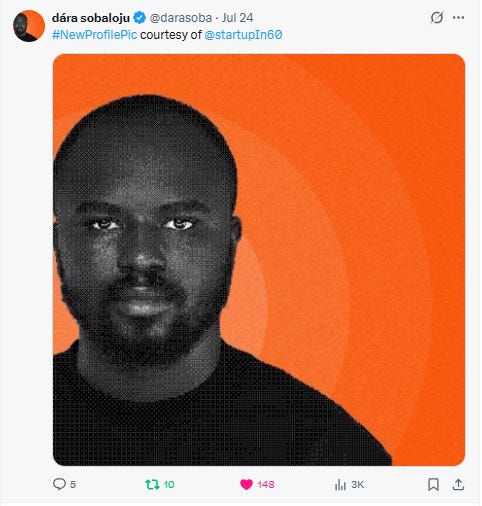
Dara changed his profile picture to the graphic our team designed for the newsletter feature.
Now I know that sounds minor. But if you understand what it means for a founder to take the creative work someone did around their story and put it on their own profile, you understand what it actually communicates. It says: this felt right. This represented me. I trust what you built around my work.
That is what in60 is trying to do, every single week. Not just write about founders. Not just publish content. Actually make the people we spotlight feel seen in a way that most media does not manage to do.
Here is what we have built so far.
We sat with Adetokunbo Ogunnoiki of LooPoint, the guy who built a mental map of clean toilets in Ibadan and turned it into a geo-mapping platform that the Lagos State Government backed. We told that story before most people had heard of him.
We interviewed Oluwasanmi Timilehin — Timmy of Evolution App, who spent four years moving money across borders on WhatsApp before building what is now a genuine global payments platform for Nigerians and Africans working internationally.
We sat with Elo Mukoro of Cr3dentials — a Nigerian-American founder building the infrastructure that lets Uber drivers and YouTube creators prove their income to lenders without a payslip or a credit score. The kind of product most people in the Nigerian tech space hadn’t heard of. Now they have.
We featured Omolara Sanni of Midddleman — the woman who got underestimated before she walked into rooms, and walked out with a ₦5 million first prize and a Lagos Angel Network investment. We named her properly and gave her the platform her work deserved.
We sat down with Benjamin Dada of Condia — one of the most respected voices in African tech media, and unpacked what it actually takes to build a publication with depth, empathy, and editorial integrity in a space that too often rewards speed over substance.
And last week, Dara Sobaloju of PewBeam, who changed his profile picture to our graphic. That one landed differently.
These are not random names. These are people building real things, solving real problems, on a continent that still does not have enough platforms willing to tell their stories with the depth and honesty they deserve.
That is what in60 is here for.
Not to be the biggest newsletter. Not to chase views. To be the platform that when a founder gets featured, they feel like someone actually understood what they were building, and cared enough to get it right.
Semudara Abayomi built in60 because he believes that distribution and storytelling is everything. That the right story of African founders has to come from African storytellers. That nobody else can tell it with the same depth or honesty. I signed up to lead this newsletter because I believe the same thing.
We want to be named in rooms. We want to be the first platform a founder thinks of when they want their story told properly. We want the African tech ecosystem to know that in60 exists, that it is serious, and that it is not going anywhere.
If you know a founder building something great and nobody is telling their story, send them to us.
If you are that founder, our inbox is open.
And if you have been reading in60 from the beginning, thank you. You showed up before we were loud. That means everything.