

You can be online all day, reply to every message, and attend every meeting, yet still get little done.
For Olamide Otasanya, a Treasury Finance Analyst and the National Coordinator of Hult Prize Nigeria, there is a much simpler way to tell whether work is actually moving: look at the evidence.
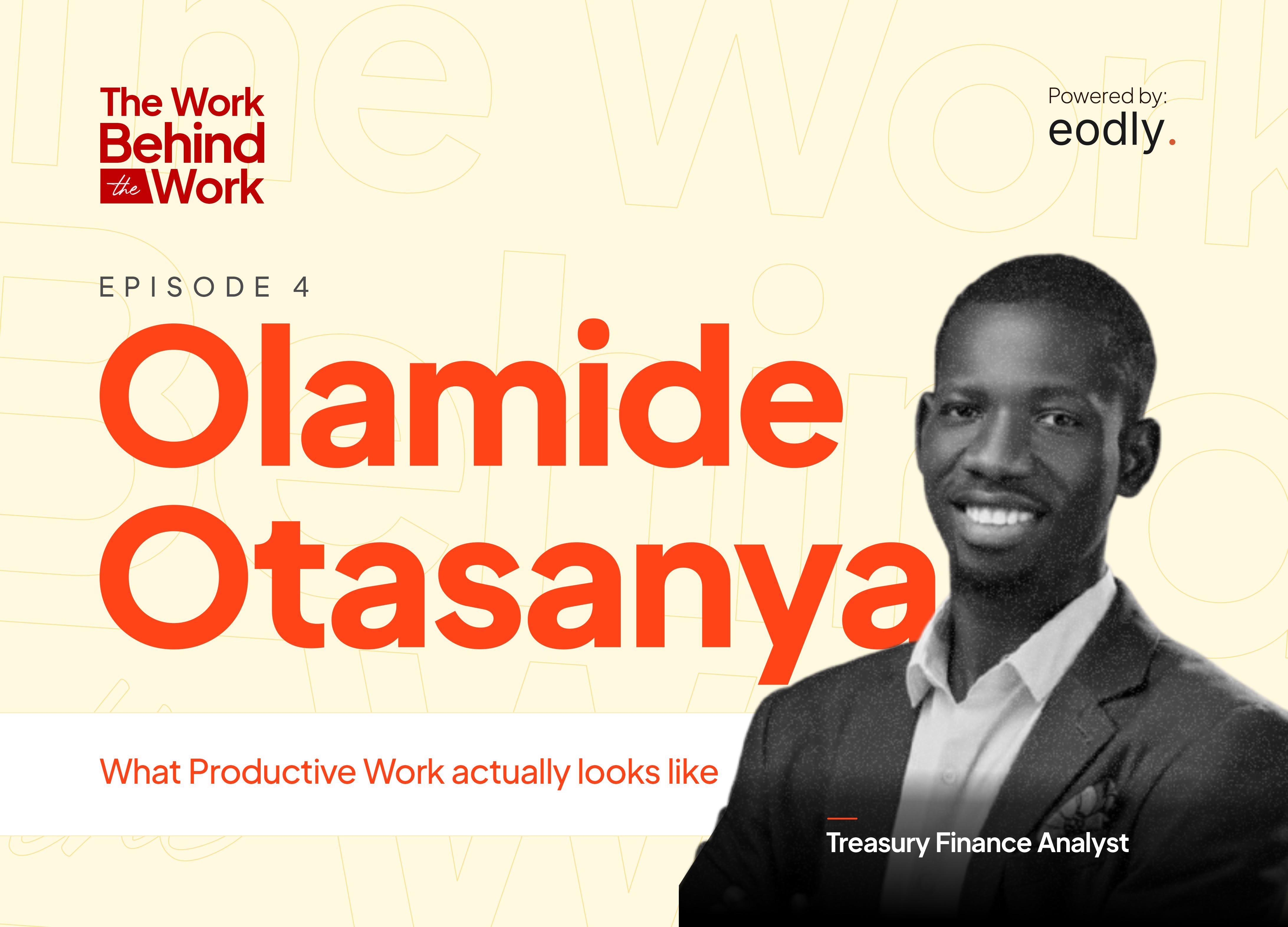
His normal day involves reconciling prior-day transactions, monitoring safeguarding balances, reviewing cash movements, posting transactions, investigating breaks and making sure everything balances before the day closes.
It is the kind of work where activity alone does not tell you much. The real evidence is in what has changed by the end of the day.
“The numbers tell me,” Olamide says. “Reconciliations clear, outstanding items reduce, balances match, and transactions move from pending to completed.”
That distinction sits at the centre of how he thinks about productive work.
In a workplace where being responsive can sometimes be mistaken for being effective, Olamide’s view is more straightforward. Good work should leave evidence behind.
The work people do not always see
Treasury is rarely a one-person operation. Olamide works across Operations, Treasury, Compliance, Accounting and banking partners, with different teams responsible for different parts of the process.
That means a delay in one place can quickly become someone else’s problem.
“Timing matters because one delay in a payment, reconciliation, or approval can affect the entire flow,” he says.
It is one of those parts of work that can be difficult to see from the outside. A transaction may look like a simple payment to the person receiving it, but there can be several checks, movements, reconciliations and approvals happening before everything is actually complete.
That is why coordination matters. The work has to move between people without losing information, ownership or momentum.
For Olamide, some of the biggest problems happen at those handoff points.
“Usually at handoff points, especially when ownership or supporting information is unclear,” he says.
His solution is not more meetings or more people checking in on each other. It is clearer ownership, deadlines and documented follow-ups.
That sounds simple, but it changes how teams work. When everyone knows what they own, what is expected, and when it needs to be done, progress becomes easier to see without someone having to constantly ask for an update.
When the status says “fine” but the work says otherwise
One of the easiest ways for teams to misunderstand productivity is to confuse an update with evidence. Someone can report that a task is on track while the actual work underneath it is already showing a problem.
Olamide has seen this happen.
“Sometimes a report can say everything is on track while a reconciliation shows an unresolved break,” he says.
When that happens, the team does not simply change the status and move on. They go back to the underlying transaction, find the gap and fix the source.
That is an important distinction.
A status update tells you what someone says is happening. Evidence tells you what is actually happening.
For a finance team, that evidence might be a reconciliation that has cleared, a balance that now matches or a transaction that has moved from pending to completed.
The same principle can apply outside finance.
A project is not necessarily progressing because someone said it is progressing. A product task is not complete because it is marked “done” in a tracker. A customer issue is not resolved because someone replied to the message.
The output has to exist.

Small blockers can become big problems
The same thinking applies when someone gets stuck. In many teams, people delay raising blockers because they do not want to appear stuck or because they assume they can solve the problem themselves before anyone notices.
Olamide thinks that can create bigger problems.
“Blockers should be raised early,” he says. “In finance, a small unresolved issue can become a larger reconciliation or settlement problem if it is left too long.”
Early communication therefore becomes part of productivity.
It is not about reporting every minor difficulty. It is about making sure an issue does not quietly sit inside a process until it affects everyone else.
That requires a team where people can say something is wrong before the deadline arrives.
And that becomes even more important when work involves multiple teams.
Accountability without watching everyone
Modern workplaces have created plenty of ways to make work visible. People can see when someone is online. They can track response times, count meetings, monitor task updates and ask for daily reports.
But visibility is not the same thing as productivity. For Olamide, the things that matter are much more concrete.
“Accuracy, completed outputs, resolved issues, and consistency,” he says.
Being online or responding quickly does not necessarily mean the work itself is getting done.
It is a useful distinction because some of the most important work can look quiet from the outside.
A person investigating a difficult reconciliation may not send many messages for several hours. Someone working through a complicated financial issue may not appear particularly busy on a calendar. What matters is whether the problem is eventually understood and resolved.
His experience coordinating Hult Prize Nigeria also gives him another perspective on the same question. Working with people and coordinating execution means progress cannot simply be measured by how active everyone appears.
Teams need to know what they own, what needs to happen next and whether the expected outcome is actually being delivered.
That is why Olamide describes a healthy, high-performing team in fairly simple terms.
“People know what they own, communicate early, and can trust each other to deliver,” he says. “Accountability should create visibility, not micromanagement.”
From status reports to evidence
This is also the problem Eodly is interested in.
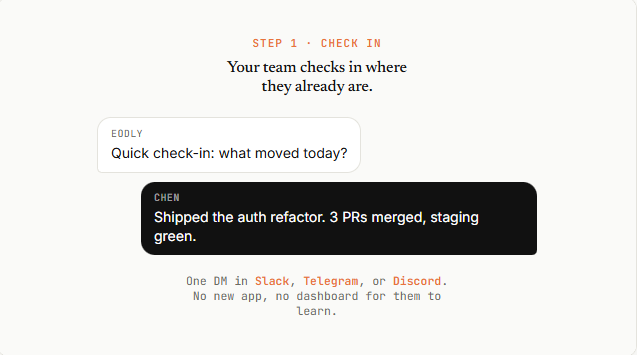
Eodly is an AI end-of-day report for founders and team leads. Each teammate sends one short check-in in Slack, Telegram or Discord; Eodly checks it against what actually happened in GitHub and Linear, and the lead gets one report on what shipped and what is stuck. It is status backed by evidence, without another meeting.
Olamide arrives at a similar conclusion from a finance perspective.
“If I could change one thing, I would move teams from status reporting to evidence-based tracking,” he says.
For him, that means clear owners, deadlines, blockers and measurable outputs. That approach does not eliminate communication. It makes communication more useful.
Instead of repeatedly asking someone whether they are making progress, the team can look at what's been completed, what remains outstanding, and what is blocking the next step.
It also creates a healthier relationship with accountability.
People know what they are responsible for. Managers have visibility into what needs attention. Teams can identify problems earlier. And nobody has to spend half the day producing updates about work that could have been spent doing the work itself.
For a Treasury Finance Analyst, the final test is still remarkably simple.
The transactions should reconcile. The balances should match. Outstanding items should reduce. Problems should get resolved.
The work should move.
And perhaps that is the simplest definition of productivity: not how busy you look while doing the work, but what is different because you did it.