

There is a point in every startup’s journey when the conversation changes.
At the beginning, it is usually about the idea. Then it becomes about customers, revenue, hiring and growth. Eventually, another question enters the room: How do we finance all of this?
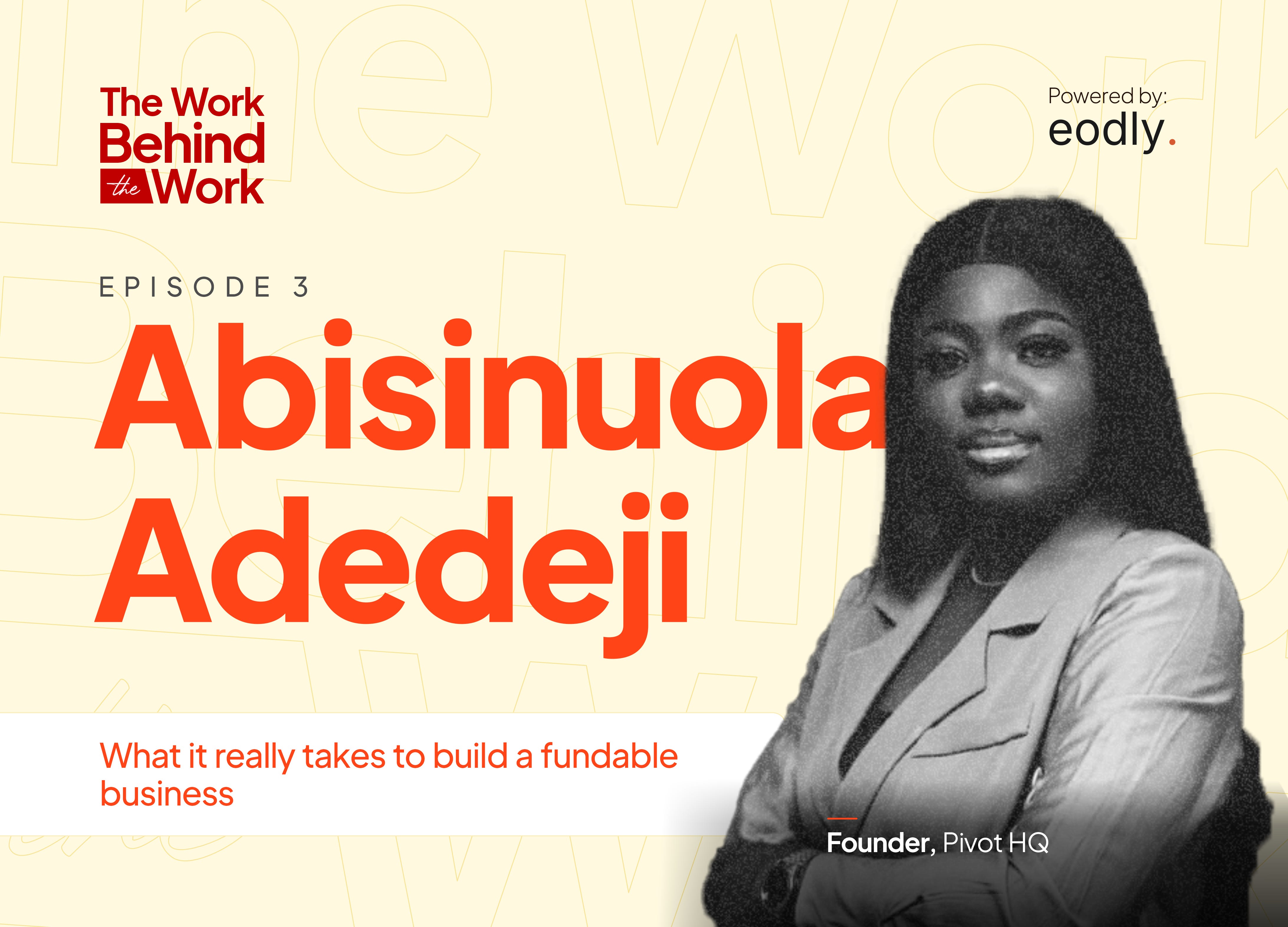
Abisinuola Adedeji has spent years close to that journey.
A management consultant and ecosystem builder, she has worked across startup programmes, partnerships, communities and business support, giving her a front-row view of companies at different stages of growth.
She has watched founders search for product-market fit, make their first revenue, build teams and eventually start asking bigger questions about capital.
That experience gradually changed the questions she was asking, too.
How do we make this business work better? How do we improve execution? How do we build the right structures?
Then came another question: “What happens when this company needs capital?”
That question pulled her deeper into venture building and venture finance, particularly the space between building a stronger business and making better decisions about the money that comes into it.
For Adedeji, the two cannot really be separated.
And that is part of what The Work Behind the Work, in collaboration with Eodly, is interested in: not just the outcome people see, but the decisions, systems and day-to-day work underneath it.
Eodly helps founders and team leads get a clearer picture of what is actually happening across their teams by bringing together signals from the tools they already use.
In Adedeji’s case, that unseen work sits around a different question: what makes a business strong enough to use capital well?
Money does not fix everything
One of the things Adedeji has learned from working with early-stage businesses is that capital tends to amplify whatever already exists in the business.
“If the business has strong fundamentals, capital can accelerate them. But if the company has unclear economics, weak reporting, poor financial controls or no real understanding of what drives growth, adding more money doesn’t automatically solve those problems.”
And that is where operations becomes important.
An investor isn’t just investing in an idea. They are ultimately investing in the company’s ability to execute that idea. How a company tracks revenue, understands customers, manages cash, makes decisions, and measures performance can become very important when looking at the business from an investment perspective.
Adedeji has also learned that being able to use capital well is different from being able to raise it.
A founder might successfully raise $500,000, but the more important question is what that $500,000 unlocks. What changes in the business because that capital came in? What milestones does it fund? What does success look like after deployment?
That is the part she finds particularly interesting: capital as a tool for building the business, not simply as a milestone to celebrate.
Look beyond the pitch deck
Adedeji prioritizes substance over presentation when evaluating early-stage companies. “I try to get underneath the story quite quickly.”
The pitch is important, but she wants to understand what happens when you start asking practical questions.
“Who is actually paying? Why are they paying? How often do they pay? What does it cost to serve them? What is changing because the product exists? Where is growth coming from? What happens if the founder stops pushing every single part of the business personally?”
At very early stages, she does not expect a company to have perfect numbers or a perfectly proven model.
What she wants to see is evidence of learning and some underlying economic logic.
A founder saying “we grew 300%” does not tell her very much by itself. She wants to understand what drove that growth.
“Was it ten customers becoming thirty? Was it one large contract? Was it a temporary campaign? Is that growth repeatable?”
For Adedeji, “the real business starts becoming visible when you can connect the customer, the problem, the revenue, the economics and the company’s ability to execute.”
That, she says, is much more interesting than a polished pitch deck.
What does it actually mean to be ready for money?
Fundraising advice often focuses on surface-level tasks like pitch decks, financial models and data rooms. But Adedeji believes capital readiness goes deeper.
It starts with knowing why the money is needed, what the money is going to do and why that is the appropriate form of capital for the business at that particular point in time.
If a founder is raising equity, what are they giving away and what does that capital enable? If debt is appropriate, can the business actually service it? If a grant makes more sense, why pursue an equity round?
There also needs to be some level of organisational readiness.
The numbers should tell a coherent story. The ownership structure should make sense. Financial records should be reliable. Founders should understand their unit economics as much as their stage allows.
But perhaps the biggest part is having a clear relationship between capital and milestones.
“I don’t think ‘we need $500,000 to scale’ is enough.”
She wants founders to ask: “Scale what? Why $500,000? What happens with $100,000? What happens with $1 million? What does the business look like after deployment?”
Capital readiness, for Adedeji, is about being able to answer those questions with some level of confidence.
Investors aren’t all looking for the same thing
One misunderstanding Adedeji sees is the idea that fundraising is primarily about convincing someone that your idea is great. It isn’t only that.
Investors are evaluating a combination of things: the market, the business model, the opportunity, the team, the evidence of execution, the risks and ultimately the potential relationship between the amount of capital invested and the return that investment could generate.
She also thinks founders sometimes approach investors as though there is one universal definition of a “good startup.” There isn’t.
Different investors have different mandates, stages, sectors, geographies, risk appetites and return expectations.
So, a company being rejected by one investor does not necessarily tell you that the company is fundamentally bad. It may simply mean there isn’t a fit between the company and that investor’s mandate.
And founders should also spend time understanding what they are saying yes to.
“The terms matter. The type of capital matters. The expectations attached to that capital matter. Who you bring onto your cap table matters.”
“Raising money is not the end of the process. It’s the beginning of a new relationship and a new set of obligations.”
The right money depends on the business
Adedeji advises founders to start with the business rather than the available capital.
At the earliest stage, the priority might simply be proving that the problem exists and that people are willing to pay for a solution.
That might not require venture capital at all. It could be bootstrapping, grants, customer revenue, friends and family, or other forms of early support.
Once there is evidence of demand, the question changes.
A company might need capital to build the product, acquire customers, hire key people or expand into a new market.
As the business becomes more mature, debt, venture debt, strategic capital or other financing structures may become relevant depending on the business.
So, for Adedeji, the question should not simply be: “How do I raise venture capital?”
The better question is: “What is the constraint on my business right now, and what type of capital is best suited to solving it?”
Sometimes the answer is equity. Sometimes it isn’t capital at all.
“Sometimes the business needs better execution before it needs more money.”
She believes that distinction is incredibly important.
The gap between money and capability
Working across founders and the wider startup ecosystem has also shown Adedeji another problem.
A company can get access to capital without necessarily having the capacity to absorb it effectively.
And she does not think that is simply a founder problem. It is also an ecosystem problem.
There has been plenty of conversation about the funding gap facing African startups. But Adedeji believes another conversation is needed around the infrastructure and capabilities businesses need to become investable, financeable and sustainable.
A founder might need $50,000 to reach a particular milestone, but the available funding mechanisms may be designed around much larger venture rounds.
Or a company may have potential but lack the financial reporting, governance or operating structure expected by a particular investor.
Sometimes, she says, there is a mismatch between what the business needs, what the capital provider offers and what the company is currently capable of supporting.
That mismatch represents an opportunity.
“I think there is a huge opportunity to build better bridges between founders and capital, not just by helping founders pitch better, but by helping businesses understand capital, prepare for it, choose it intelligently, and deploy it effectively.”

Venture building is more than writing a cheque
For Adedeji, venture building is about increasing the probability that a company can become a strong, sustainable business. Capital can be part of that, but it is only one input.
Good venture building can mean helping a founder validate the problem before they spend heavily on building a product. It can mean helping them think through the business model, recruit the right people, establish the right financial structure, find distribution, develop partnerships or access the right networks.
It also means understanding when to push growth and when to slow down and fix the foundation.
Adedeji sees venture building as creating the conditions around a company that allow it to compound: “capital, talent, strategy, networks, infrastructure, governance and execution.”
She has spent significant time close to founders and businesses. Now, she wants to deepen her understanding of how capital is raised, structured, managed and deployed, and how those decisions affect the companies receiving it.
Her goal is not just to understand how to help a founder become fundable, but to understand the investor’s side of that equation too.
“I want to be able to operate at that intersection between company building and capital allocation.”
For her, understanding the founder side, the ecosystem side and the capital side offers a more complete view of how companies and ecosystems actually get built.