

When Dolapo Oshikoya was in school, product management was nowhere on his career plan. He was studying cybersecurity and had his sights set on becoming a cybersecurity analyst. He was taking courses, building his knowledge and trying to find his way into the field.
But even then, there were clues that his career might eventually take a different direction.
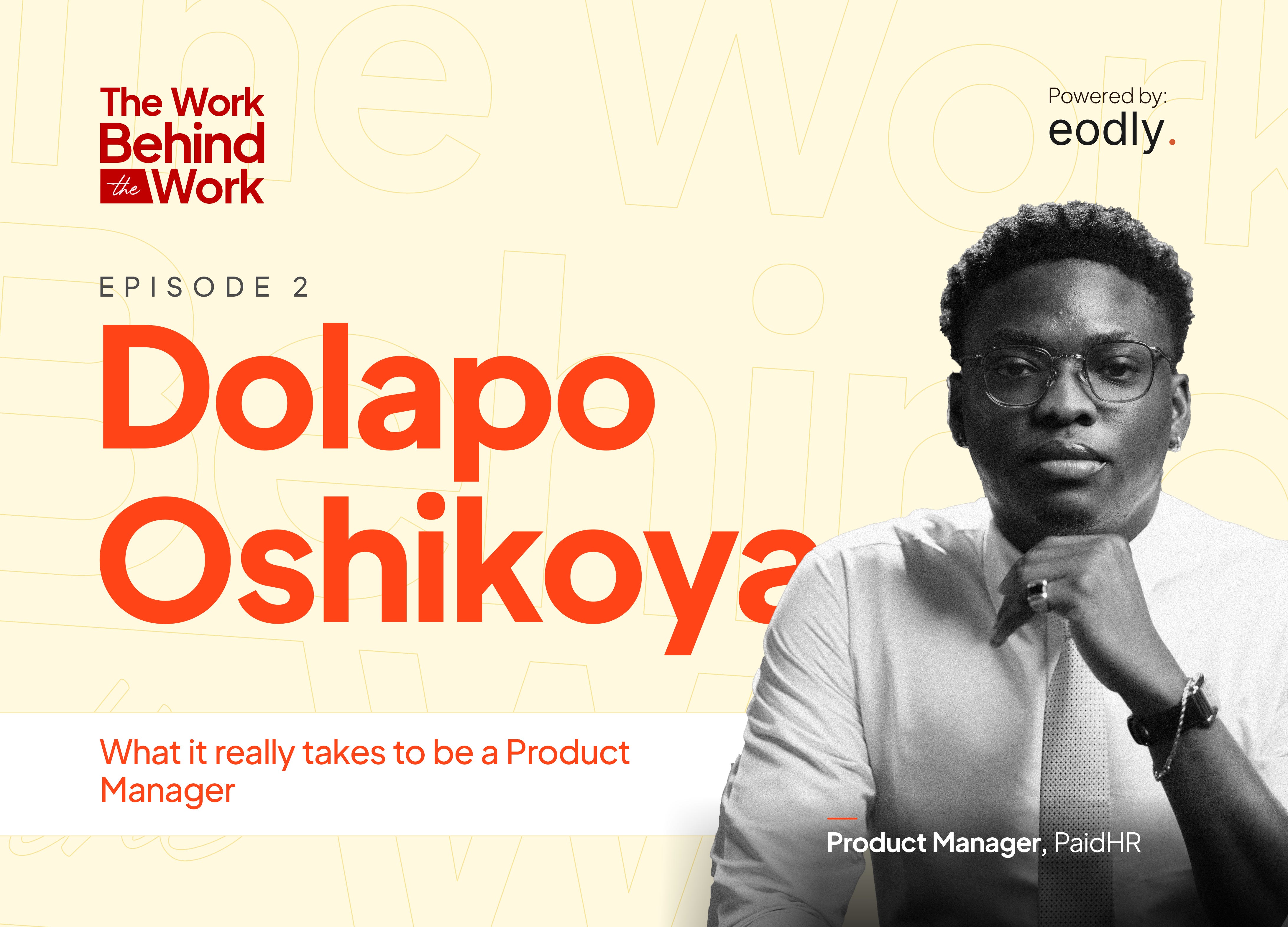
Dolapo was deeply involved in leadership. He served as a class governor and later took part in student legislative activities, including serving as a speaker. Outside school, he was also running different businesses.
He was already spending his time organizing people, solving problems, making decisions and figuring out how to get things done.
He just didn’t know that these were skills he would eventually use as a Product Manager.
He stumbled into product management
Dolapo’s entry into product management was almost accidental.
In 2021, while he was still in school, an academic strike gave him some extra time. But the idea had actually appeared in his mind shortly before then.
He had attended a tech event where someone asked participants what they did and what areas of technology interested them. A few days earlier, Dolapo had come across a breakdown of different technology career paths.
Product management was one of them.
“I remember reading about it and thinking, ‘Okay, this is a career I could potentially explore,’” he says.
The idea stayed with him.
So when someone at the tech event asked him what he did, he remembered product management. “I told the person, ‘I’m getting into product management.’”
At that point, he hadn’t formally started working in product. But saying it out loud made the idea feel real.
When he got home, he began learning properly. He took courses, researched the role and started understanding what Product Managers actually did.
The more he learned, the more he noticed that some of his existing experiences already looked like pieces of the job.
His leadership roles had taught him how to work with people. His businesses had taught him how to organise and solve problems. His interest in technology gave him the technical curiosity to understand products.
What began as something he stumbled into slowly became a career.
“Honestly, I stumbled into product management,” he says. “But I stayed because I found a connection between what I was naturally interested in, what I had already been doing, and the kind of work product management allowed me to do.”
Today, he works as a Product Manager at PaidHR.
And along the way, he discovered that the job was very different from what he had imagined.
He thought the Product Manager was almost the CEO
Product management can be a tricky role to understand, and Dolapo learned this firsthand. At first, he pictured a Product Manager as a mini-CEO, someone with all the power to boss people around and make things happen.
"One of my biggest misconceptions about product management was that the Product Manager was basically the next after the CEO," he admits. He thought that leading a product meant having absolute authority, directing teams, and ensuring every task was completed.
However, once he stepped into the role, reality quickly set in. He discovered that responsibility doesn't automatically grant you the power to dictate. A Product Manager must understand the problem, set the course, make key decisions, and unite diverse teams. Yet, they don't necessarily have the authority to simply order everyone around.
This means a huge part of the job revolves around conversations. Dolapo even has a playful way of describing it, calling the PM an "errand person." He's not talking about literal errands, but rather the constant back-and-forth between individuals, teams, discussions, and challenges, all in an effort to keep everything cohesive.
This "errand running" is often overlooked. People see the finished product, the new feature, when it's released.
What they don't always see is the Product Manager diligently moving between the customer who brought up the issue, the designer crafting the user experience, the engineer constructing it, and the business stakeholders debating whether it's even worth building.
It's a behind-the-scenes hustle that keeps the product journey on track.
A normal week? Expect chaos
Dolapo's week as a product manager is far from predictable. It's a dynamic role, constantly shifting based on the product's current stage. A week dedicated to understanding customer issues bears little resemblance to one focused on building or launching a new feature.
During the discovery phase, Dolapo immerses himself in customer conversations, gathering feedback to pinpoint their genuine needs. He then collaborates with internal stakeholders to align with business objectives, ensuring the team tackles the most impactful problems.
Next comes crafting the roadmap: prioritizing tasks, deferring others, and integrating new initiatives within the product's broader vision. There's also the unseen effort of execution: meticulously writing tickets, dissecting requirements, clarifying build specifications, and fielding engineers' questions.
He works closely with designers, ensuring everyone grasps not just the 'what' but also the 'why' behind their work.
Data plays a crucial role. Dolapo analyzes analytics to understand user behaviour: which features are popular, where users disengage, and if anything deviates from the team's expectations. Sometimes data provides clear answers; other times, it sparks further questions.

The unexpected is a constant companion. A new stakeholder request, an engineer's concern, a customer unearthing an unforeseen problem, or a business shift that re-evaluates a recent decision- these are all part of the job.
As Dolapo puts it, "Product management comes with a certain level of chaos. You have a plan for the week, but you also have to be comfortable with the fact that the plan can change."
This adaptability, he believes, is perhaps the most vital aspect of the role.
The product is only part of the problem
Product courses can teach you frameworks.
They can teach you how to gather requirements, understand customers, build roadmaps and collect feedback. But some lessons only become clear when the product leaves the whiteboard and meets the real world.
For Dolapo, one of those lessons is what happens when you actually take a product to customers.
“You eventually learn that being a Product Manager isn’t just about building a product; it’s about understanding the environment it operates in and being able to navigate everything that comes with putting that product into the real world,” he says.
The product itself is only one piece.
There is the business around it. There are customers with different needs. There are internal expectations. There are limitations around resources and execution.
A good product can still run into problems if the team doesn’t understand the environment around it. That is the kind of thing a job description rarely captures.
When everybody wants their request first
One of the hardest parts of product management is deciding what not to do. Almost everyone around a product has a reason why their request matters.
A customer wants something fixed. An executive has a new idea. Sales needs a feature. Engineering has its own priorities. Suddenly, everything is urgent.
Dolapo doesn’t believe the loudest person in the room should automatically get their way. Instead, he looks at the bigger picture.
What does the business need most right now? What problem is the team trying to solve? How many customers are affected? How serious is the problem? Then comes the practical side.
How much engineering capacity is available? How difficult will the work be? What resources are required? And, perhaps most importantly, what will have to wait if this request moves to the front of the queue?
For Dolapo, prioritization means putting those requests beside each other and judging them against the same factors. Business value. Customer impact. Effort. Capacity. Resources.
Sometimes the answer is simply:
“This is a valid request, but it’s not the priority right now.” And that doesn’t mean the idea is bad. It just means something else needs attention first.
“I don’t know” is part of the job.
Product managers like Dolapo don't need to know everything. They connect teams (engineers, designers) and understand customers. "It's okay for them to ask questions when they don't understand something, rather than pretending."
This prevents mistakes. "They also need to be open to changing their minds if new information comes up."
The goal isn't having all answers, but helping the team find solutions. "Not admitting what you don't know can lead to bigger problems for the product, team, and customers."
You can’t manage people with a framework.
Product management has plenty of frameworks. But people don’t always fit neatly into one. Dolapo has learned this through working with different personalities.
Some people are easy to work with. Others require more patience. Some communicate directly. Others need more time or a different approach. And sometimes, there are things happening in someone’s life that you simply don’t know about.
That has changed how he thinks about leadership.
“As a Product Manager, you’re often the person facilitating the room,” he says. “You’re leading meetings, running briefs, having conversations, and trying to get everyone moving in the same direction.”
But facilitating a room isn’t the same as controlling it. “You have to understand them and learn how to work with them.”
For Dolapo, that has meant becoming more patient, listening more and learning not to react too quickly. “What works with one person might not work with another,” he says.
At the end of the day, “it’s different folks, different strokes.” It is a lesson no product framework can fully teach.
The PM people don’t panic when they see calling
Dolapo, a seasoned Product Manager, envisions a leadership style rooted in approachability. He strives to be the kind of PM whose name on a phone doesn't incite panic, but rather fosters open dialogue and collaboration.
His motto: "Whenever you see my call or my text, no pressure. Don’t panic."
This humorous quip underscores a profound philosophy. Dolapo champions an environment where challenging ideas, constructive disagreement, and alternative suggestions are not just tolerated, but encouraged. He aspires to be a PM people enjoy working with, someone who can "have a conversation, figure things out, and get the work done."
While seemingly simple, this approach, refined through years of experience, is deeply intentional. Product management, for Dolapo, transcends roadmaps and features; it's about navigating uncertainty, discerning when to lead and when to listen, embracing humility, and adapting to change. It's about instilling order without instilling fear.
Dolapo recognizes that the journey of learning is continuous, especially in an ever-evolving landscape of technology, business, and work dynamics. His honest acknowledgement of still "figuring it out" is perhaps the most powerful testament to his authentic leadership.