


You can have the best idea in the room and still fail to get the work done.
A deadline slips. A client changes their mind overnight. A designer saves a file in the wrong folder. Someone is clearly talented, but the work just isn’t landing. And every team has that one little thing nobody thought to write down, until it blows up three weeks later.
This is the side of creative and tech work nobody really talks about.
We celebrate the product, the campaign, the launch, the numbers. But underneath all of that is another story: the mess it took to make it happen. The coordination. The follow-ups. The work behind the work.
That’s what this new in60 series is all about. So, Get in!
Every week for four weeks, we’re sitting down with the people who actually make teams, products, and campaigns move. Not for polished leadership speeches; we want the real stuff. What happens when the Slack messages pile up, the deadline refuses to budge, and someone has to step up and make the call?
And since keeping track of what everyone is actually doing is one of the hardest jobs in running a modern team, this series is powered by Eodly, an AI end-of-day report built for founders and team leads juggling mixed teams.
Eodly plugs into the tools your team already uses and turns the scattered traces of the day into a clear, sourced picture: what shipped, what didn’t, who’s making progress, and where things might be quietly slipping.
If you’re building or running a team, give Eodly a quick look. Then come back; we’ve got plenty more work to unpack.
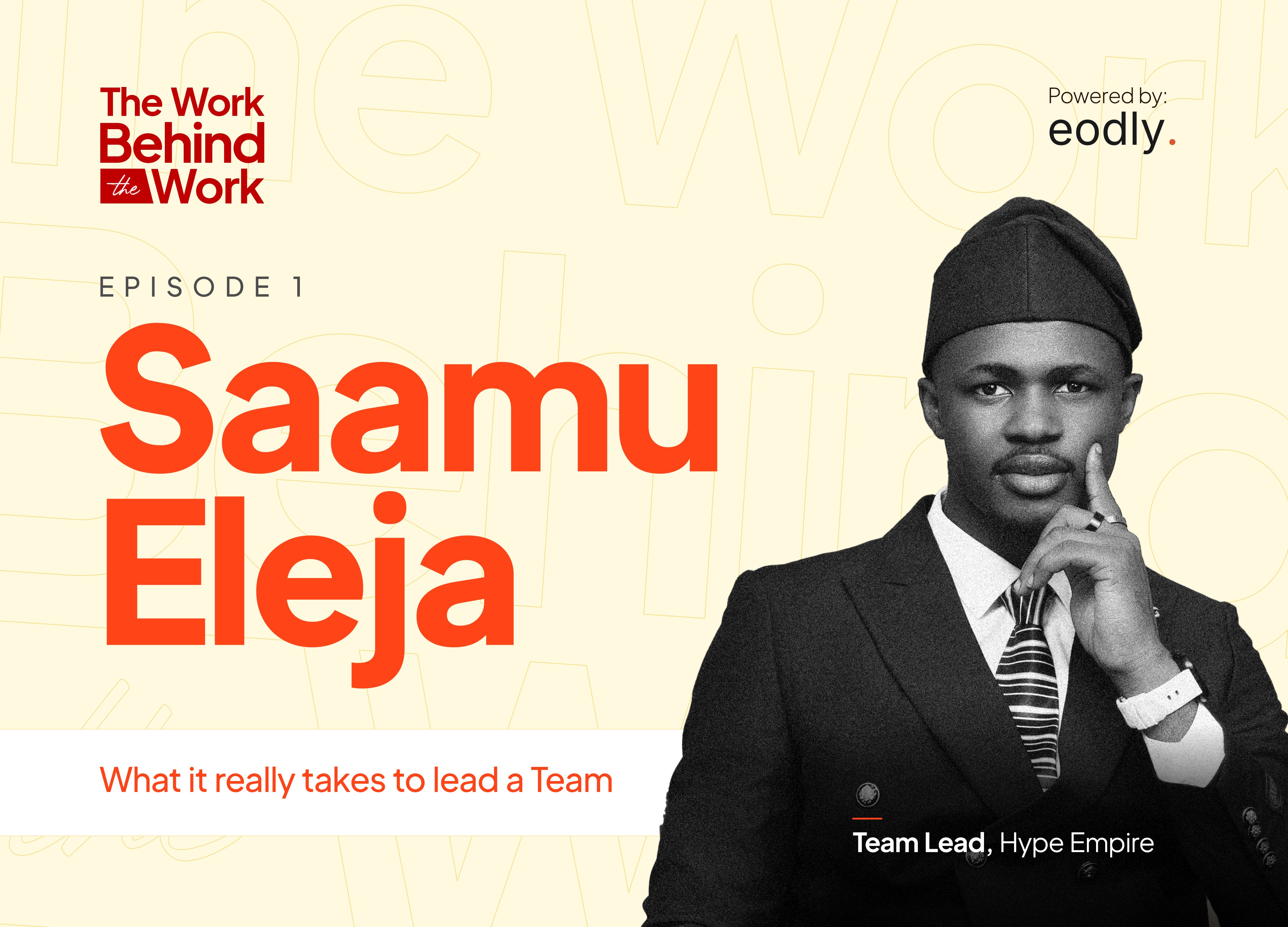
For episode one, we sat down with Saamu Eleja, a marketing, PR, and events pro who’s spent years building teams and running projects through HYPE EMPIRE. And Saamu is refreshingly candid about what that actually looks like on the ground.
First, get everyone looking at the same thing
For Saamu, managing a team starts with something surprisingly simple: everybody needs to understand what success looks like.
He calls it the team’s “northstar metric”, the bigger outcome that ultimately determines whether the work is considered successful.
Every person’s task, even the tiny ones, needs to connect to that outcome. But Saamu has also learned that leadership isn’t just about making people afraid of missing the target. He wants his team to know that he is someone they can relate to when things go wrong.
“I’m not just a boss to fear,” he says.
There is structure, though. Regular meetings. Task updates. Impromptu check-ins when necessary. Everyone should know there is a “judgement day” coming, a point where the work will be reviewed, so there is a reason to keep moving.
It sounds straightforward. In practice, it is one of the hardest parts of managing people: turning a group of individuals with different personalities, motivations and working styles into one team moving towards the same destination.
Give creatives room to be creative
This becomes even more complicated when the people you’re managing are creatives.
Saamu believes creative freedom isn’t something a manager should simply announce. It has to exist inside the working relationship. His approach is to make his own methodology clear, understand how each person thinks, and then create enough room for both to work.
His video editor, Dhaveid, is a good example.
Saamu says he barely gives Dhaveid concepts anymore because Dhaveid has become good at creating ideas from scratch. After working together since 2024, he understands where Saamu is likely going with a deliverable and can often prepare ahead of time.
But Saamu is clear that this didn’t happen overnight. Dhaveid is calm and gentle, he says, and that meant Saamu had to understand that clarity worked better for him than a “jimjim” approach. That is an important distinction.
Good managers don’t necessarily manage everyone the same way. They learn what makes different people work. Clock it.
When things go wrong, don’t start panicking
Events are particularly good at exposing bad systems. Something will go wrong. The question is what happens next.
Saamu’s first move is usually an urgent conversation with his “right-hand man”, someone he can quickly review the situation with before deciding how to respond to the client. But his bigger lesson came from making mistakes himself.
He has lost money and peace of mind by failing to account for things going sideways before a project even started. Now, he tries to build contingencies into the agreement with clients from day one. If there is a possibility that the plan changes, the client needs to know. And, importantly, it needs to be documented.
Because verbal agreements have a funny habit of disappearing when everyone remembers the conversation differently. For Saamu, experience helps, but systems built from previous experience are even more valuable.
The things you cannot delegate
So how does he decide what he should personally handle?
His answer is brutally practical:
What can get spoilt now and ruin the entire work or the client’s trust in me?
Those things stay within his sight. He delegates because people need to grow and because a manager cannot possibly do everything forever. But budgets are different.
“Na me client go hold first when time reach to report,” he says. Funny, isn’t it? But true.
Translation: if something goes seriously wrong with the money, the client is probably coming to him first. So he isn’t handing that responsibility away just yet.

Busy is not the same as productive
We asked Saamu how he knows whether a team is genuinely progressing or simply drowning in work. His answer was probably the shortest of the entire interview:
“Progress in KPI achievement. FULL STOP!!!”
And honestly, there isn’t much more to add.
A team can have meetings all day. Send hundreds of messages. Stay late. Have twenty tasks open at once. None of that necessarily means anything is moving.
The question is whether the team is getting closer to the outcome it was brought together to achieve.
And yes, sometimes the problem is money
Saamu believes poor communication, unclear ownership and too many priorities can all destroy momentum. But he adds another problem that managers sometimes avoid talking about: incentives.
Especially money.
His argument is simple: people work differently when there is a clear promise attached to the work. When that promise disappears, disengagement can follow.
And even with the right incentives, Saamu admits that some people simply aren’t suited to working within a particular team.
After three years of building HYPE EMPIRE, he has seen enough to know that there isn’t a perfect management system that will make everyone fit.
What happens when someone isn’t delivering?
This is where leadership gets uncomfortable.
What do you do when someone is hardworking and talented but the work still isn’t good enough? Saamu starts with communication. Clearly, but diplomatically.
Before blaming the person, he looks at himself too. Was the instruction unclear? Was something overlooked? Can the goal be broken down further?
Sometimes, he says, reducing the person’s goal into smaller wins helps them experience what successful delivery actually looks like. But patience has a limit.
If the problem continues, the conversation becomes firmer, consequences are attached, and eventually, letting the person go becomes a possibility.
“Capitalism is real,” he says.
Talent and hard work are valuable, but they are not the final objective. The team still has to succeed.
When everyone is tired
Deadlines don’t care that your team is exhausted. Saamu’s response is to remind people why they started and make them understand what happens if their part of the work isn’t done. But he also believes a leader has to show some humanity.
Sometimes that means unwinding with the team. Sometimes it means spending from the project budget. Sometimes, he says, it may even come out of the leader’s own pocket.
Because people remember how you treated them when the pressure was high.
And then, in classic Saamu fashion, he adds:
“PRAY TOO ABEGGGGG!!!”
There are apparently some project management frameworks that don’t make it into the Harvard Business Review.
The lesson he learned the hard way
Perhaps the biggest thing Saamu got wrong about leadership was assuming people would automatically buy into his vision just because it made sense to him.
HYPE EMPIRE taught him otherwise.
People arrive with different cultures, different experiences, different ways of thinking. What’s obvious to one person isn’t obvious to the next. And then there’s over-familiarity; a leader can be approachable and still need clear structure.
Saamu describes the danger of losing that structure like Bayern Munich’s infamous 8–2 demolition of Barcelona in 2020. (Sorry, Barca fans.)
The point lands hard: get too comfortable, and you can wreck the very thing you’re trying to lead.
If there’s one takeaway Saamu wants every project leader to carry, it’s this: never start a project without an agreement that holds everyone accountable: the client, the manager, and every person doing the work.
That goes for communication too. In Saamu’s view, spoken instructions are useful, but written instructions are safer.
A conversation fades. A written record stays. And that matters when the client changes the brief, when an event time shifts, when a designer needs to dig up an old file, or when someone suddenly says, “And I no see/hear am oo.”
The record is there to fall back on. And according to Saamu, that alone can spare you plenty of trouble.
The manager’s job changes when the team grows
One of the biggest transitions in leadership is moving from being good at the work yourself to getting other people to be good at it. Your success is no longer measured only by your personal output. It is measured by what the people around you are able to achieve.
That is where delegation becomes unavoidable. And, for many managers, uncomfortable. Saamu admits that micromanagement is something many good managers go through because it is difficult to hand over something you’re personally good at and trust somebody else to do it differently.
But eventually, you have to let go. Otherwise, the manager becomes the bottleneck. His solution isn’t simply delegation, though. It’s documentation.
A good manager, he says, should document processes and build methodologies from them. Because when leaders leave, what often disappears isn’t just the person.
It’s how they knew to get things done.
Consideration before confrontation
Saamu has one message for founders and senior managers: Consideration before confrontation.
Before deciding someone has failed, give them room to explain. Before deciding your solution is the only solution, understand what happened.
And while founders should be ambitious, he believes they should also be realistic about what they are asking their teams to achieve. Be as careful with your goals as you are with your budgets. Because the people executing the idea are the ones who eventually have to make the idea real.
So, what would Saamu do with a new team?
Give him a fresh team tomorrow and 30 days to make it high-performing?
He wouldn’t open with a pep talk. He’d start by studying the room.
Their strengths. Their weak spots. Their existing culture. How they actually get things done. Only then would he shape his approach around what he found. Because after years of leading teams, Saamu has learned something that sounds obvious but is surprisingly easy to forget: you can’t lead people properly until you truly understand the people you’re leading.
And maybe that’s the real work behind the work.

It’s the thousands of small calls about people, expectations, communication, trust, pressure, and accountability: the quiet decisions that decide whether the big things ever actually get finished. That’s what we want to uncover here.
This is just the first edition of The Work Behind the Work.
Next week, we’ll meet another person who makes things happen behind the scenes, and ask a different kind of question: what does it honestly take to make a team work?