


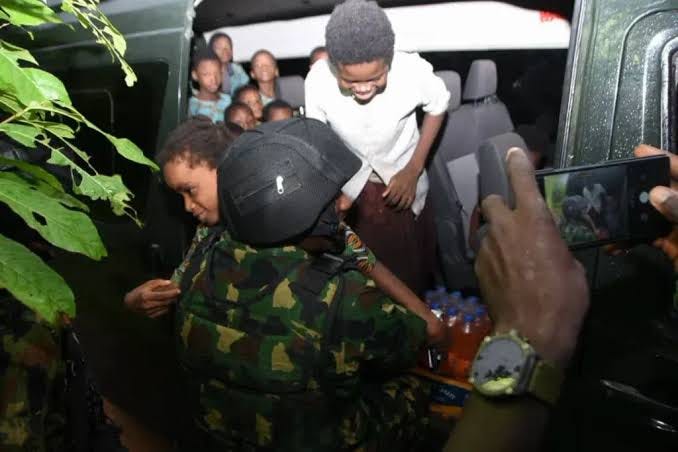
Good morning. Before anything else today, the children are home.
On July 10, 2026, the Presidency confirmed that all 39 pupils and seven teachers abducted from three schools in Oriire Local Government Area of Oyo State on May 15 had been rescued by Nigerian security forces. 56 days in captivity.
Eight kidnappers arrested. Several others neutralized. No ransom paid. No prisoner exchange. The government held firm on that, and the security agencies delivered.
Nine terrorists were killed during the rescue operation, while eight others were arrested and are in DSS custody. The rescued pupils and teachers looked emaciated and weak but were evidently joyful. One of the rescued teachers, in a video shared by the Presidency, thanked President Tinubu directly.
The children were seen eating biscuits. For 56 days, their families had been waiting. That wait is over.
Now let’s talk about the part that should make every Nigerian who cares about technology and security deeply uncomfortable.
Every call left a trail. Nobody could follow it fast enough.
While those children were in the forest, their kidnappers were on their phones. Constantly.
They made video calls to families to show hostages being beaten, using the footage as ransom pressure. They requested airtime and mobile data from captives. They negotiated multimillion naira payments over calls. In at least one documented case from a similar kidnapping ordeal, a victim was handed a kidnapper’s phone and instructed to buy ₦10,000 worth of mobile data for two specific numbers.
For a moment, the victim held something investigators spend weeks trying to obtain, a direct digital line to the people holding him.
And yet. The kidnappers remained free for weeks.
This is the contradiction TechCabal’s reporting laid bare this week in a detailed investigation into why Nigeria still cannot find kidnappers despite the phones, the SIM registration, the NIN linkage, and the call records sitting in telecom servers across the country.
The answer is not that the technology doesn’t exist. It is that the gap between what technology can theoretically do and what actually happens on the ground in Nigeria is vast, and closing it requires more than laws and policies.
What the tech actually looks like, and where it breaks down
Here is what Nigeria has on paper. Under the NCC’s Lawful Interception of Communications Regulations, law enforcement can legally access subscriber information, call records, location data, and, where justified, intercept communications during criminal investigations.
Every SIM card is linked to a National Identification Number. Telecom operators maintain detailed call records including numbers, duration, timing, and frequency.
Here is what that doesn’t give you: a GPS pin.
Cell-site analysis, the technique of tracing which telecom tower handled a call, can tell you the general area a call came from. In Lagos, where towers are densely packed, that might narrow a search to a few streets. In Oyo’s rural forests, a single mast can cover dozens of kilometres of terrain. Knowing a call came from a particular tower tells you almost nothing about where in that coverage area the caller is standing.
And the kidnappers know this. According to security analysts, many kidnapping groups deliberately travel kilometres from their hideouts before making ransom calls, then return. In some networks, the person negotiating the ransom is operating in a completely different state from the people guarding the hostages. The person on the phone and the person with the children are never in the same place.
On top of that, due process requirements mean law enforcement cannot simply demand subscriber data in real time without going through legal channels, a process that introduces delays precisely when speed is most critical. And increasingly, criminal networks are moving communications to WhatsApp, Telegram, and Signal, where end-to-end encryption makes content interception extremely difficult even when investigators have legal authority.
The Oriire rescue worked because security agencies spent over a month doing something that technology alone cannot do: mapping the network, identifying ringleaders, dismantling logistics, and making multiple arrests across Oyo and other states to disorient the group before moving in. It was intelligence-led. Patient. Methodical. And it worked.
But it took 56 days. Two teachers died, one shot during the attack, one beheaded in captivity. Families paid enormous psychological costs. Teachers in Oyo went on strike. And the broader question remains unanswered: in a country that has spent billions on telecoms infrastructure, NIN registration, and digital identity systems, why is this still so hard?
What technology could actually fix, if anyone decided to
The honest answer is that Nigeria does not have a technology problem. It has an integration problem.
The data exists. The legal frameworks exist. The tools, cell-site analysis, call record databases, digital forensics, exist. What does not exist, consistently, is the operational infrastructure to use them together quickly enough to matter during a live kidnapping situation.
Real-time coordination between telecom operators, the NCC, the DSS, military intelligence, and the police requires systems, workflows, and pre-authorized protocols that mean investigators do not spend 48 hours on paperwork before they can access a call record. Countries that have cracked this, the UK, the US, parts of East Africa, did not do it by buying better technology. They did it by building the institutional plumbing that lets existing technology work together without bureaucratic delay.
Terra Industries is building drone and battlefield intelligence infrastructure in Nigeria. The government has AI-capable surveillance systems. The components of a functional security tech stack exist. The question is whether the will to integrate them and fund the institutional coordination that makes them useful, matches the scale of the problem.

7,568 people were abducted in Nigeria between July 2023 and June 2024 alone, according to SBM Intelligence. Kidnappers demanded ₦10.9 billion in ransom during that period.
The children from Oriire are home. That is a genuine victory and it deserves to be celebrated. But the next set of children should not have to wait 56 days. And closing that gap is a technology and governance problem that Nigeria has the tools to solve, if it decides to.
Similar read:

🤝 Collab Corner
Founders Connect Live is back in Lagos. And this year, the interview is the entire event.
No panels. No multiple stages. No filler. Just one stage, one host, and the kind of unscripted conversations that actually tell you how building in Africa really feels.
FC Live Show 2026 happens on Saturday, July 18 at Jewel Aeida, Lekki Phase 1 from 12PM, and the lineup is serious. Deepankar Rustagi of OmniRetail, the company the Financial Times named the fastest-growing company in Africa in 2024. Paul Onwuanibe of Landmark Group doing an open AMA with the audience. Fola Olatunji-David, the operator whose take on what quietly kills companies is always worth hearing. And more.

Peace Itimi — who has conducted over 100 long-form interviews with African founders is hosting.
That is exactly the kind of room in60 wants you in.
📅 July 18, 2026 · 📍 Jewel Aeida, Lekki Phase 1, Lagos · ⏰ 12PM
🎟️ Get your ticket → tix.africa/discover/fcliveinlagos2026