Most people encounter a frustrating problem, complain about it and move on. Tolulope Olonibua tends to do something else. He looks at the problem and starts thinking about how it could work better.
That habit has taken him from software engineering roles across different countries to building products of his own, often alongside the people who experienced the problems firsthand.

Today, his work spans cost-sharing, delivery and software development through products including LetsGoHalf, Rydafirst and StudioMVP. The products are different, but the way he arrives at them is remarkably similar.
Someone encounters a problem. Tolulope sees an opportunity. Then he builds.
That approach has also shaped how he works with other people. His most interesting products have not simply come from ideas he developed alone. They have grown out of conversations and collaborations with people who understand the problem from the inside.
The idea that became LetsGoHalf
The idea behind LetsGoHalf existed before the company did. Tolulope had been thinking about the difficulty of finding people to split expenses with, whether it was rent, subscriptions, transportation or other recurring costs.
Then Joyfulness Adeniyi, an influencer, posted a video looking for someone to split bills with.
The video went viral. For Tolulope, it was the validation he needed.
He reached out to Joyfulness and convinced her that what looked like a simple social media request could become something much bigger: a platform that could connect people who wanted to share costs but did not necessarily know each other.
That became LetsGoHalf.
Tolulope built the product, including its matching and verification systems and mobile application, while Joyfulness became an important driver of the content and community growth behind the platform.
The partnership gave the startup something that many early products struggle to find: both the technology and the audience.
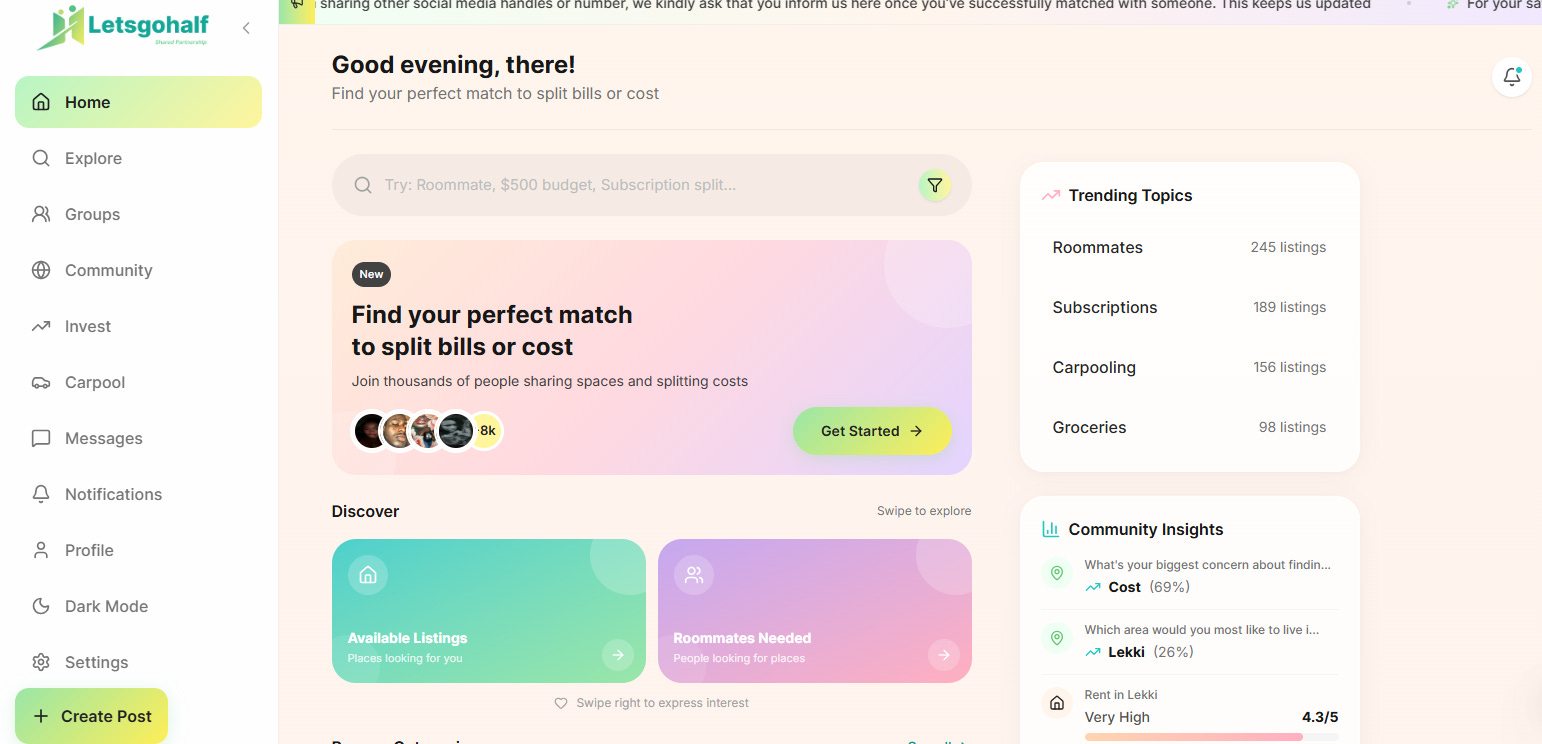
LetsGoHalf allows people to find verified strangers with compatible needs and split costs together rather than relying only on friends or people already in their networks.
The platform has grown to around 1,300 registered users, with real paying transactions processed through Paystack.
Much of that growth has happened organically through Instagram content, without advertising spend. That growth story is important because LetsGoHalf did not begin as a conventional startup launch. It started with a person asking a very ordinary question online:
Who wants to split this with me? Tolulope saw a business inside the question.
Then another viral story became a company
Rydafirst followed a similar path. This time, the problem came from a Lagos dispatch rider who posted a video about completing a delivery and not getting paid. The video went viral. Tolulope reached out to him.
After speaking about the problem, the two decided to build a solution together.
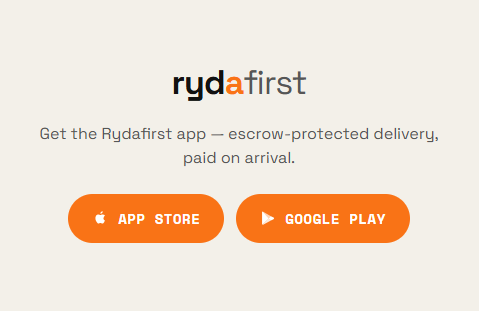
That became Rydafirst, an escrow-backed delivery platform designed to protect both customers and dispatch riders. The model is straightforward.
A customer pays into escrow. The rider completes the delivery. Once the delivery is confirmed, the rider’s payment is released automatically. The platform uses a one-time code and GPS verification to confirm the delivery. The goal is to reduce the uncertainty on both sides of the transaction.
For riders, completing a delivery should not mean wondering whether they will eventually receive their money. For customers, paying for a delivery should come with greater confidence that the transaction will actually be completed.
Rydafirst went live on iOS and Android on August 6, 2026. The team is currently taking a measured approach to growth, with a vetting phase for riders in Lagos before expanding more widely.
Again, the pattern is familiar. Tolulope did not start by deciding that he needed to build a delivery startup. He found a person with a problem, understood the problem and built with that person.
LetsGoHalf and Rydafirst may operate in different spaces, but their origins are remarkably similar. Both began with a real person experiencing a problem publicly. Both involved Tolulope reaching out rather than simply observing from the sidelines. And both became products through collaboration.
That may be the clearest explanation of how Tolulope approaches building.
He is less interested in inventing problems for technology to solve than he is in finding problems that already exist and figuring out where software can make a difference.
It is an approach that has followed him through his career.
From mathematics to software
Tolulope studied mathematics at the Federal University Oye-Ekiti before moving into software development.
His career took him to Lilab, a software consultancy in Lima, Peru, where he worked on client-facing applications using React and TypeScript. He also worked with C# and .NET while contributing to a backend feature for one of the company’s clients.
He later worked at Crypto University in Dubai before joining MTN Nigeria.
At MTN, he works as an engineer across several application projects, including FMA, the company’s internal fleet management platform used by staff, where he builds and improves features.
Those experiences have given him exposure to different types of products, teams and users. But they have also provided something else: the technical foundation to turn the problems he notices outside work into functioning products.
Building beyond his own startups
That has also led to StudioMVP, his app development studio. Through StudioMVP, Tolulope builds web and mobile products for founders and businesses, sometimes taking equity in projects he believes in.
The studio allows him to work across different ideas and industries without having to be tied to a single product. It also fits naturally into the way he has built his own ventures.
Instead of seeing software development as simply writing code, he approaches it as a way of taking an idea from an early problem to something people can actually use.
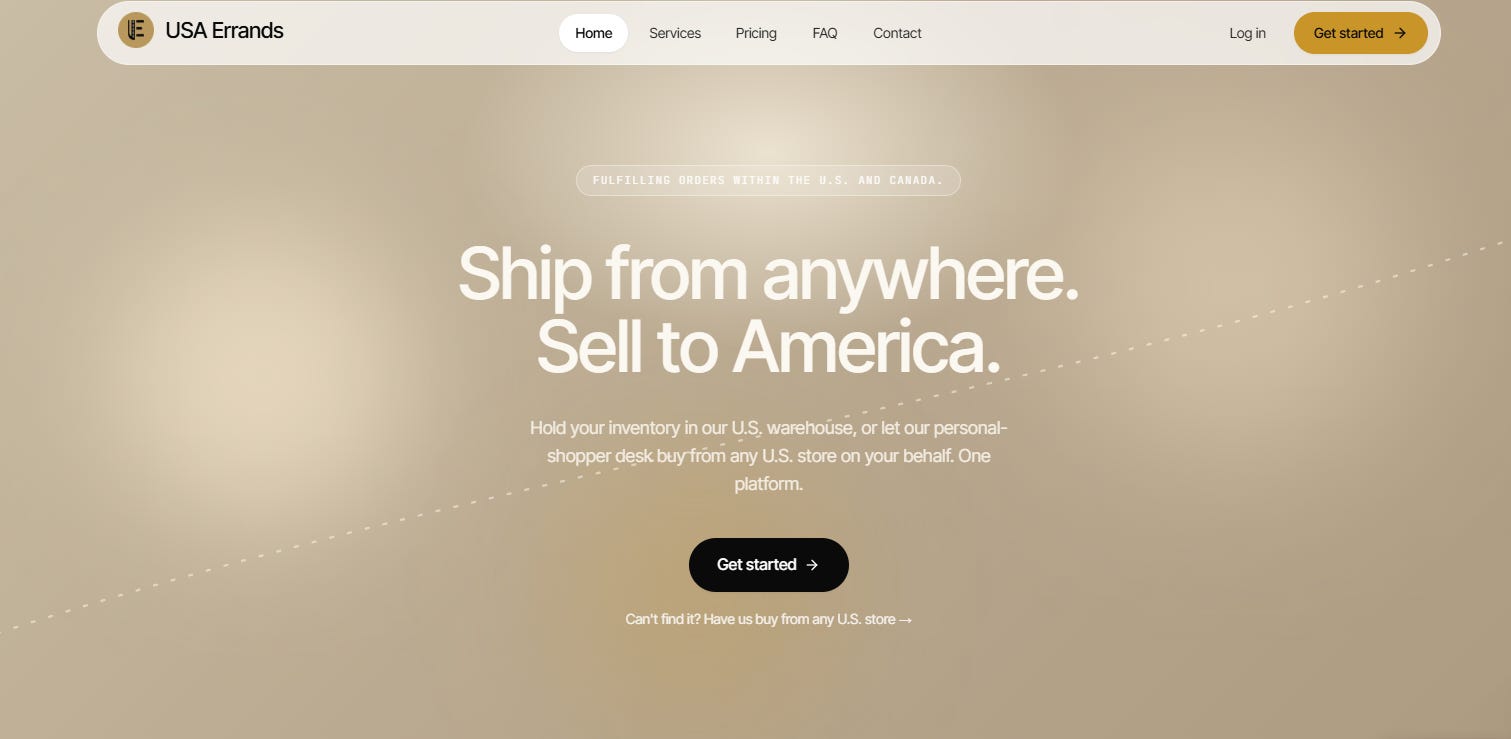
One of the ventures he has also co-founded is USA Errands, a fulfilment and personal-shopping platform serving international sellers in the US and Canada.
But he keeps that work separate from StudioMVP’s client work.
For Tolulope, the bigger value of building across different products is the exposure it gives him to different problems.
Each project teaches him something about users, payments, verification, operations or simply how difficult it can be to turn a good idea into something people will consistently use.
The builder is becoming the story
There is no single product that completely explains Tolulope’s journey yet. Instead, there is a pattern.
He had an idea around shared expenses, then found Joyfulness Adeniyi already talking publicly about the same problem and built LetsGoHalf with her. He saw a dispatch rider’s viral story about an unpaid delivery, reached out and built Rydafirst with him.
He works with founders and businesses through StudioMVP, turning their ideas into software.
And alongside all of this, he continues to work as an engineer, gaining experience from larger products and teams. The common thread is not a particular programming language or technology.
It is curiosity. Tolulope seems drawn to the gap between the way something currently works and the way it should work. And once he finds that gap, he wants to close it.
What comes next?
For now, Tolulope is building across several fronts. LetsGoHalf is growing its user base and exploring more ways for people to share costs safely. Rydafirst is testing its model with dispatch riders in Lagos before a broader rollout. StudioMVP continues to work with founders and businesses building products of their own.
And Tolulope continues to develop his own ideas alongside them. His journey so far suggests that another product may not necessarily begin with a pitch deck or a carefully planned startup thesis.
It could begin with another viral post. Another frustrated customer. Another founder describing a problem. Another person asking why something has to be so difficult. That is where Tolulope appears to be most comfortable.
Not simply building software for the sake of building software, but finding something that is broken, understanding why it is broken and then asking:
What if I built a better way? So far, that question has produced LetsGoHalf, Rydafirst and a growing body of work through StudioMVP.
And it may just be the beginning.