


Clinton Mbonu did not stumble into education technology. He was practically born into it.
His siblings teach across different levels of the Nigerian school system. His family’s relationship with education is not professional; it is personal, almost ancestral. And for Clinton, teaching is the activity that makes him feel most alive.
“Teaching is when I feel most alive,” he said, simply and without decoration.
That background makes it easy to understand why, after building technology across payments, logistics, e-commerce and AI-powered conversational commerce, he kept coming back to the same problem. Not because it was a good market opportunity. Because he cared about it in a way that was hard to explain to people who did not.
What he kept seeing made him uncomfortable.

Someone joins an online course. They get added to a WhatsApp group. Two PDFs land in their inbox. And then, silence. No structure. No follow-up. No accountability. No real way of knowing whether anything was learned.
“Many people are selling content,” Clinton told in60, “but content alone is not education.”
That gap, between what people were selling and what learning actually requires, became Lightbulb.
What Lightbulb actually is
The simplest way to understand Lightbulb is to understand what it is not.
It is not another platform where you upload videos and hope people watch them. It is not a course marketplace where creators list their content and learners scroll through options. It is not a basic learning management system designed to administer classes.
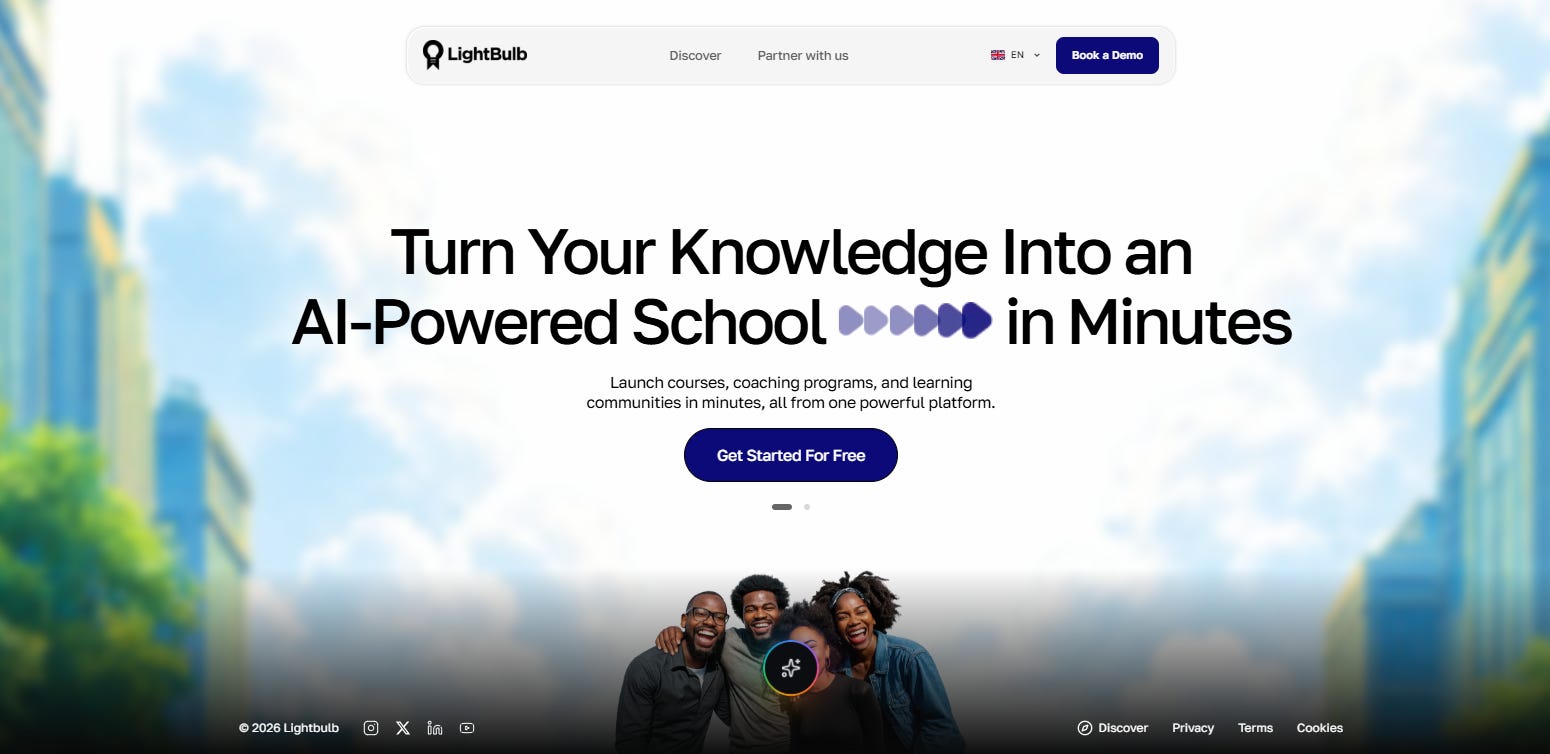
Lightbulb is the infrastructure that holds the entire education experience together, from the moment a learner discovers a programme, through enrolment, payment, learning delivery, assessment, progress tracking, and credential issuance, in one system.
Clinton described the current reality for most educators and institutions without it: “They combine payment links, spreadsheets, messaging groups, video-conferencing tools and assessment systems to run a single programme.” Every tool is separate.
Nothing talks to anything else. The educator spends more time managing logistics than actually teaching. The learner gets a fragmented, confusing experience and often drops out before finishing.
Lightbulb connects all of those functions. An institution or independent educator can create a branded programme storefront, manage applications and enrolments, collect payments, deliver live and self-paced learning, track attendance and progress, support struggling students with AI, conduct assessments, and issue credentials, all without leaving the platform.
The keyword Clinton keeps returning to is outcomes. Not enrolment numbers. Not content views. Whether the learner actually completed something, learned something, and can demonstrate it.
“Our goal is not simply to help people access more content,” he said, “but to help them complete programmes, demonstrate what they have learned and achieve meaningful outcomes.”
The institutions and the educators
Lightbulb currently works with 20+ institutions and independent educators and has 5,000+ students on the platform. Those numbers tell part of the story. The details behind them tell more.
In July 2026, Lightbulb signed a partnership agreement with the Institute of Education at the University of Nigeria, Nsukka, one of Nigeria’s most established teacher education institutions, becoming the Institute’s technology partner for remote and outcome-driven professional learning programmes. The rollout covers approximately 20+ professional courses. That is not a pilot. That is a full institutional adoption.
The platform also deployed infrastructure supporting academic administration and learning delivery at Shanahan University, supported two other tertiary institutions with similar systems, and processed more than ₦1.5 billion in institutional school-fee transactions. The Femi Jubal Foundation recently adopted Lightbulb to host and manage its coaching and learning programmes.
Clinton’s systems, across his decade of building education technology, have reached over 200,000 people and processed billions of naira. Lightbulb is where that experience has been concentrated and rebuilt into a single, coherent platform.
The recognition has followed. The Institute of Education at UNN gave him an Education Innovator and Mentor Award in 2026.
He was named Emerging Tech Platform Builder of the Year at the Titans of Tech Awards in 2025, and Best Tech Emerging Visionary at the Achievers Awards International in 2023.
The harder problem: keeping people
When I asked Clinton which side of the market had been harder to serve, institutions or learners, his answer revealed something important about how he thinks about the problem.
Institutions are harder to convince. They have multiple stakeholders, established processes, and legitimate concerns about data ownership and long-term dependence on an external provider. “They do not only need good software,” Clinton said. “They need confidence that the company behind it understands education and will remain accountable after deployment.”
But learners present a different kind of challenge. They are harder to keep. “Access to content is not the same as access to learning,” Clinton said. People start with genuine enthusiasm. Then work happens. Financial pressure happens. Life happens.
The momentum that felt strong in the first week begins to slow, and without structure, community, and someone noticing when things go quiet, learners drift away before they finish.
That tension between institutional trust and learner engagement has shaped almost every decision inside the product.

Where AI fits and where it does not
Clinton is careful about how he talks about AI in Lightbulb, and that carefulness itself says something.
He does not use it as a marketing claim. He uses it where it solves a specific, real problem: the delay between a learner needing help and actually getting it, and the difficulty of an educator keeping track of what is happening across a large cohort.
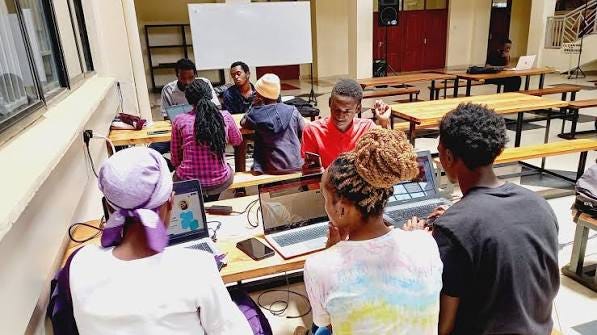
Inside Lightbulb’s learning communities, AI acts as an assistant teacher, grounded in each programme’s materials. It can understand questions, provide explanations based on the course content, and handle routine enquiries when the educator is not available.
Questions that need human judgment or context get escalated to the educator. The learner gets faster help. The educator stays in the loop without being overwhelmed.
AI also transforms learning documents into bite-sized, multimedia experiences, simpler explanations, audio, and assessments, adapted to where the learner currently is. The same material, made more accessible without changing what is being taught.
The roadmap extends into AI agents that build learner progress profiles and flag early signs of disengagement, so educators can intervene before a student becomes invisible inside a growing class.
“The goal is not to replace teachers or attach a chatbot to every screen,” Clinton said. “It is to make learning more responsive, help educators intervene earlier and ensure that fewer students become invisible inside a growing class.”
Where this is going
Clinton is direct about the ambition. African institutions are the starting point, not the ceiling.
Five years from now, he wants Lightbulb to be part of the infrastructure through which institutions and trusted educators create, distribute and deliver modern learning programmes, helping them reach learners beyond physical campuses, operate sustainably, and understand whether students are genuinely progressing.
But the larger vision is a global commerce and outcomes network for education. Any credible institution or expert should be able to transform their knowledge into a structured programme. Any learner should be able to discover it, receive personalised support, complete meaningful assessments, and carry verifiable evidence of what they learned.
“We are beginning in Africa because we understand the market, its institutions and its challenges,” he said. “But the problem of fragmented education, weak accountability and uncertain learning outcomes is global.”

A software engineer and four-time founder who grew up around teachers, built across five different industries over a decade, and came back to education because the problem was still broken.
That is the version of the story that makes sense when you read it backwards. Clinton Mbonu was always going to build this. It just took a decade of building everything else first to know exactly how.