


Oluwaseyi Fadahunsi grew up watching his family run businesses. The kind where the hustle is real, the hours are long, and the money, most of the time, just disappears somewhere between the sales and the expenses without anyone being able to explain exactly where it went.
He went on to study computer science in Germany, worked on IT infrastructure and security for a US state agency, and contributed to open-source projects including GitLab and OpenTelemetry.
The kind of career trajectory that takes you far from the daily reality of a Nigerian provision store owner or a fabric trader working from a roadside stall.
But the thing about growing up around small businesses is that certain questions never leave you. So when Oluwaseyi started asking business owners a simple question: how much profit did you make last month? and found that almost none of them could answer, he was not surprised. He was just finally ready to do something about it.
Not because they were careless. The sales were in WhatsApp chats. The expenses were in their heads. The debts owed by customers were scattered across old notebooks, or just remembered, until they were not.
That is what Kudilo is built to fix.

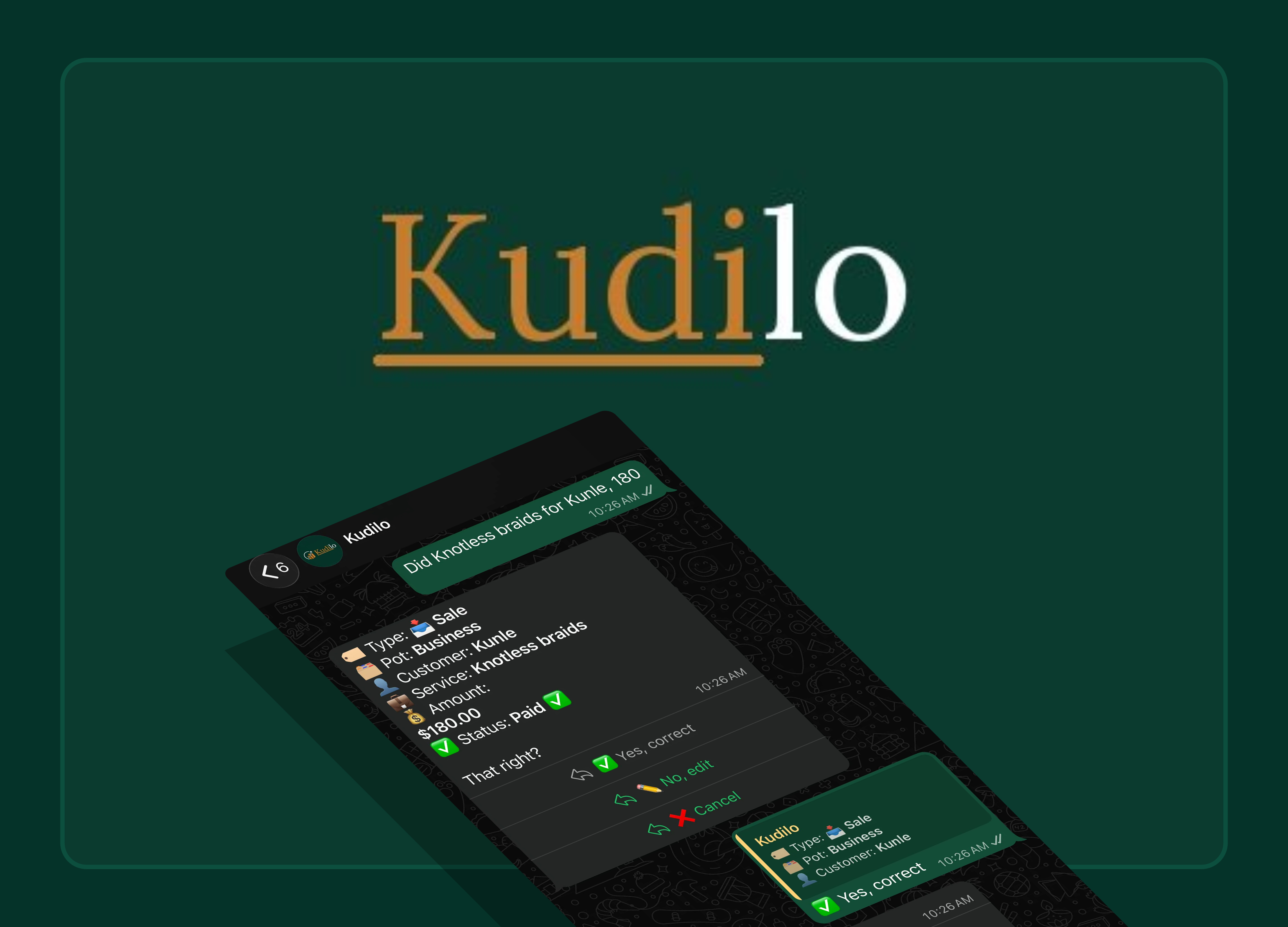
The product has a deceptively simple premise. A business owner types what happened into WhatsApp, in whatever words they would naturally use, and Kudilo turns it into a proper record.
“Sold 3 wigs to Amaka, 8k each, she paid 10k.” One sentence. Four facts embedded in it: a sale, a customer, a total, and a balance still owed. Kudilo reads it, extracts all four, and gives the merchant a short confirmation card to check. If something is wrong, they say so in normal words, and it fixes it.
Most business tools ask the user to do the hard work, learn the structure, understand what a debit is, pick the right category, fill the right form.
Kudilo flips that completely. The merchant does the easy part, which is saying what happened. Kudilo does the hard part, which is understanding what that means and turning it into a record.
“Teaching a machine to pull those facts out of normal speech is much harder than building a form,” Oluwaseyi told in60. “But that’s the right place for the difficulty. Hard for us, easy for them.”
The choice to build inside WhatsApp was not an aesthetic decision. It was a practical one rooted in how small business commerce actually works in Nigeria.
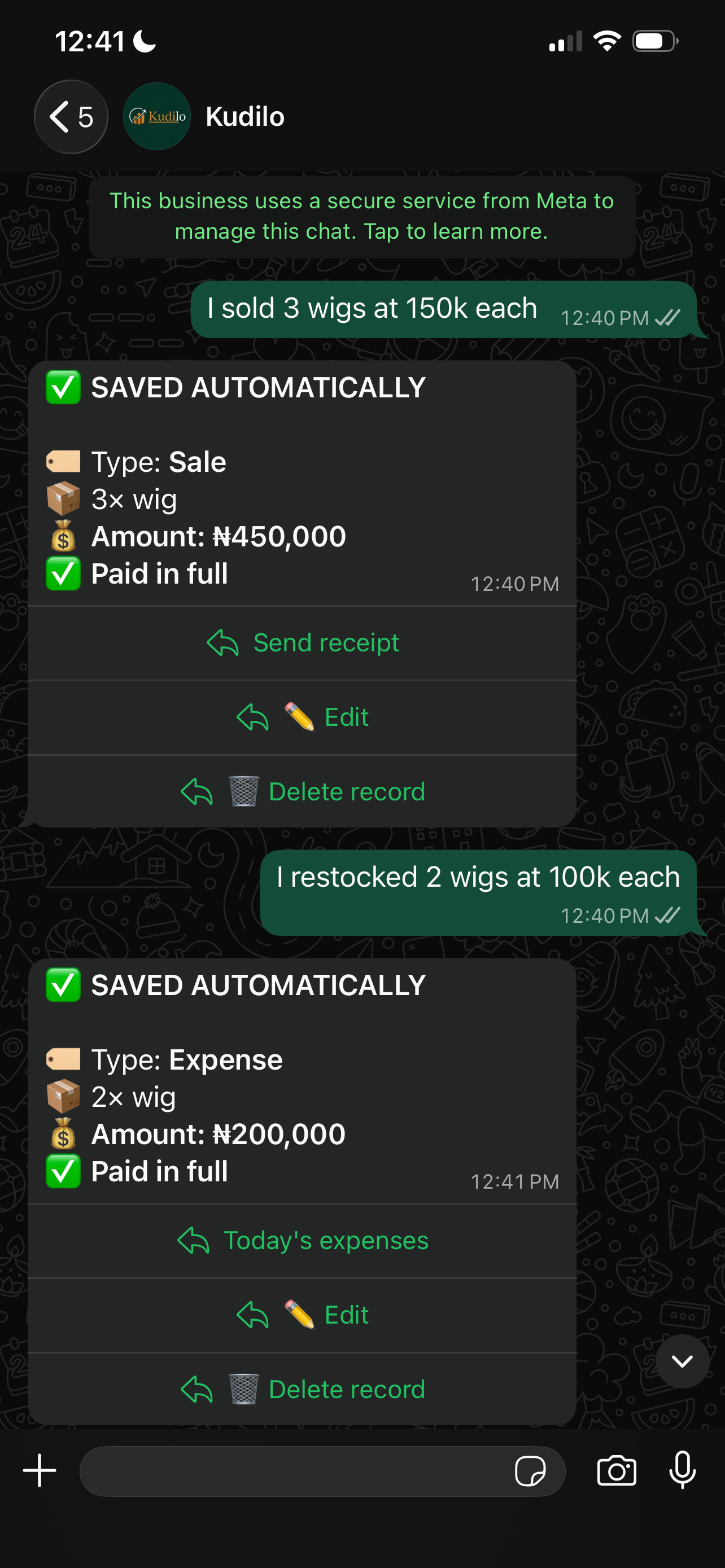
The customer messages you on WhatsApp. You agree on the price there. They send the transfer receipt there. They tell you they will pay on Friday, also there. Asking a merchant to close that chat, open a separate app, log in, and fill a form is asking them to do four extra steps for something that does not earn them anything in the moment.
Most of them will not do it. Not because they are not interested in tracking their finances, but because the friction is just high enough to kill the habit before it starts.
Kudilo removes that friction entirely by being where the merchant already is. It also understands how they actually type: English mixed with Pidgin, amounts shortened, messages sent quickly between customers. “Sold 3 wigs to amaka 8k each she go pay balance friday” is a perfectly valid Kudilo entry. If it only understood the tidy version, it would work in a demo and fail in real life.
Samuel Abidakun, co-founder and CTO, brings the security layer that makes this work at the level of trust it requires.
A security expert with fintech experience at Moniepoint and Convexity, his background in penetration testing and application security means Kudilo is built to handle the kind of financial data small businesses are now trusting it with, seriously.
In less than three months since launching in June 2026, Kudilo has onboarded 534 merchants and recorded over 10,000 transactions representing roughly ₦500 million in business activity. Thousands of invoices and receipts have been generated through the platform.
The whole thing has been built entirely bootstrapped, no investors, no external funding, just two engineers who believed the problem was worth solving.
What those early merchants have taught the team has already changed the roadmap in three specific ways.
Fixing records matters as much as creating them. People make mistakes, duplicate entries, or realize something was wrong later. If they cannot correct it easily and in the same conversational way they recorded it, they stop trusting the product. So editing by chat has become just as important as recording by chat.

People send pictures. Receipts, transfer screenshots, supplier notes. Photo-based recording has moved from a planned future feature to a real part of the current product.
And once merchants trust Kudilo with their sales, debts, and expenses, they start asking for more: inventory, ordering, bookings, customer-facing tools. The product is being pulled in that direction by the people using it, which is usually a sign that you have built something that actually works.
The most common reason merchants come to Kudilo is not bookkeeping in the abstract. It is a specific, urgent question: who owes me, and how much?
Selling on credit is completely normal in Nigerian informal commerce. One customer pays part now, another promises next week, and after a while the amounts pile up in ways that become impossible to track from memory.
Asking Kudilo “Who owes me?” and getting back a clear, current list- that is the moment the product’s value stops being theoretical and becomes obvious.
The second most common need is looking professional. Merchants want to send proper invoices and receipts with their business name on them, not screenshots or handwritten notes. They come for the document, but the transaction gets recorded in the process.
Profit comes eventually, but it is usually the deeper need that surfaces once someone has been using the product for a few weeks and starts to see the full picture of their business for the first time.
The version of Kudilo that Oluwaseyi is building toward is bigger than bookkeeping. It is a business suite that any merchant, informal or formal, small or growing, can use simply by talking to it.
You should be able to ask how much you made this week, which products are actually making you money, who still owes you, and what you spent this month, and get a clear answer immediately.
For informal businesses especially, there is something more significant buried in that vision. Many of them are real, profitable operations that are almost invisible on paper because no records exist. If Kudilo is quietly structuring that business activity as it happens, merchants are building a financial history without ever having to think of themselves as people who need accounting software.

That history has implications beyond the business itself, for access to credit, for relationships with suppliers and landlords, for the ability to grow in directions that are currently closed off to businesses that exist only in memory and WhatsApp chats.
A hairstylist does not need to start seeing herself as a business that needs software. She needs to know that Ngozi still owes her ₦12,000 and that last week was better than the week before. If one WhatsApp message gives her that, everything else is just details.
Try Kudilo:
Web: kudilo.com
X: @wearekudilo
Instagram: @wearekudilo
LinkedIn: https://www.linkedin.com/company/112961978/
in60. Telling the stories that matter.