


Someone in Lagos wants to buy a $10 iTunes gift card. Simple enough request. Except it is not simple at all.
First, they need to find a platform they can trust, which already eliminates half the options because too many of them have disappeared with someone’s money at some point.
Then they download an app. Create an account. Go through verification. Top up a wallet. Wait for the wallet to reflect. Place the order. Wait again. And if anything goes wrong at any point in that chain, good luck reaching anyone who actually picks up.
Ibrahim Pelumi Lasisi watched this happen enough times to decide someone needed to fix it. So he did.

Ibrahim is a full-stack developer based in Sheffield, UK. Before Cardron, he was doing client work through his company Devloopr Web Solution Ltd and building side projects like WorqNow.ai and OnlineQuickTools.com, the kind of builder who is always watching for a problem worth solving and then quietly going ahead and solving it.
The problem that became Cardron was not something he researched from a distance. He saw people around him, in Nigeria especially, struggling to buy digital products that should have been straightforward. Gift cards, virtual dollar cards, gaming credits, eSIMs. Things that exist to make life easier, gated behind processes so frustrating they became problems in themselves.
Worse, some of the platforms selling these products were outright scams. People sent money and got nothing. And even the legitimate ones made the experience feel like jumping through hoops just to spend your own money.
“I saw people get scammed,” Ibrahim told in60. “That frustration is what made me build Cardron.”
The idea Ibrahim landed on was not to build another platform with a better interface. It was to not build a platform at all, at least not one anyone has to find, download, sign up for, or learn how to use.
Cardron lives on WhatsApp.
You message the number, say what you want, a $10 iTunes gift card, a $25 virtual dollar card, an eSIM for travel, and Cardron handles everything from there.
The bot picks up the message immediately, reads it using an LLM built directly into the system, processes the payment through bank transfer or crypto, checks the code against real suppliers, and sends the delivery back to your WhatsApp chat within minutes.
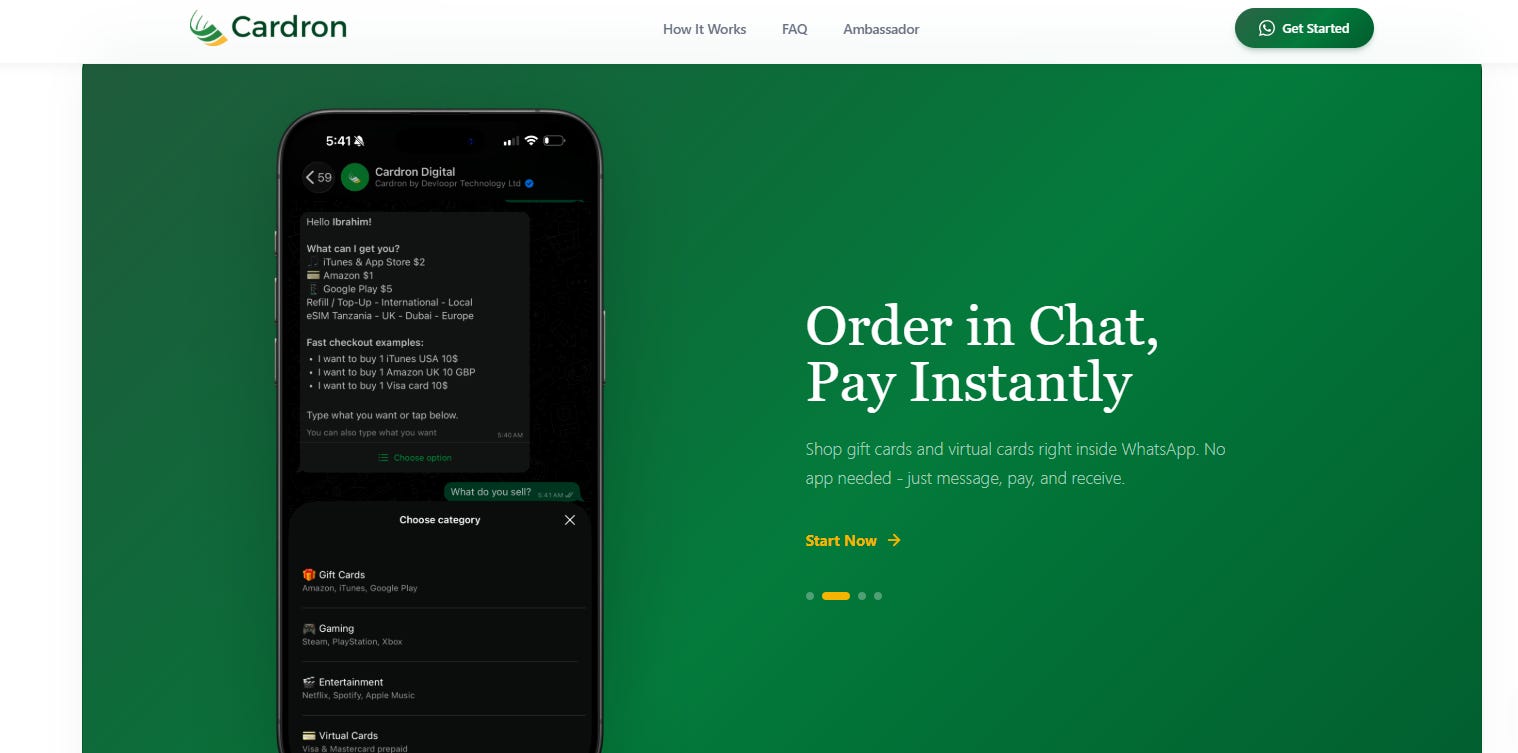
The whole interaction feels like texting a friend who happens to be very fast at sourcing digital products.
“Why make them download another app, create another account, learn another interface?” Ibrahim said. “Just meet them on WhatsApp. No app fatigue, no new sign-ups. Just a quick chat, pay, and you’re done.”
Behind that simple WhatsApp conversation is a backend doing real work, admin tools handling inventory, payment tracking, order management, and automated alerts that flag failed orders before a customer even has to ask. The customer sees a smooth chat. The system behind it makes sure nothing falls through the cracks.
The products Cardron brings together: gift cards, virtual dollar cards, eSIMs, gaming credits, might look like a random collection to someone looking from the outside. Ibrahim sees them as the same thing in different packaging.
Someone needs a gift card to send a friend abroad. Someone else needs dollars to pay for a Figma subscription or a Netflix plan that does not accept Nigerian cards. Another person is travelling and needs mobile data without a local SIM.
A teenager wants to top up their Roblox account. Different situations, same underlying need: get me digital access, right now, without stress, from somewhere I actually trust.
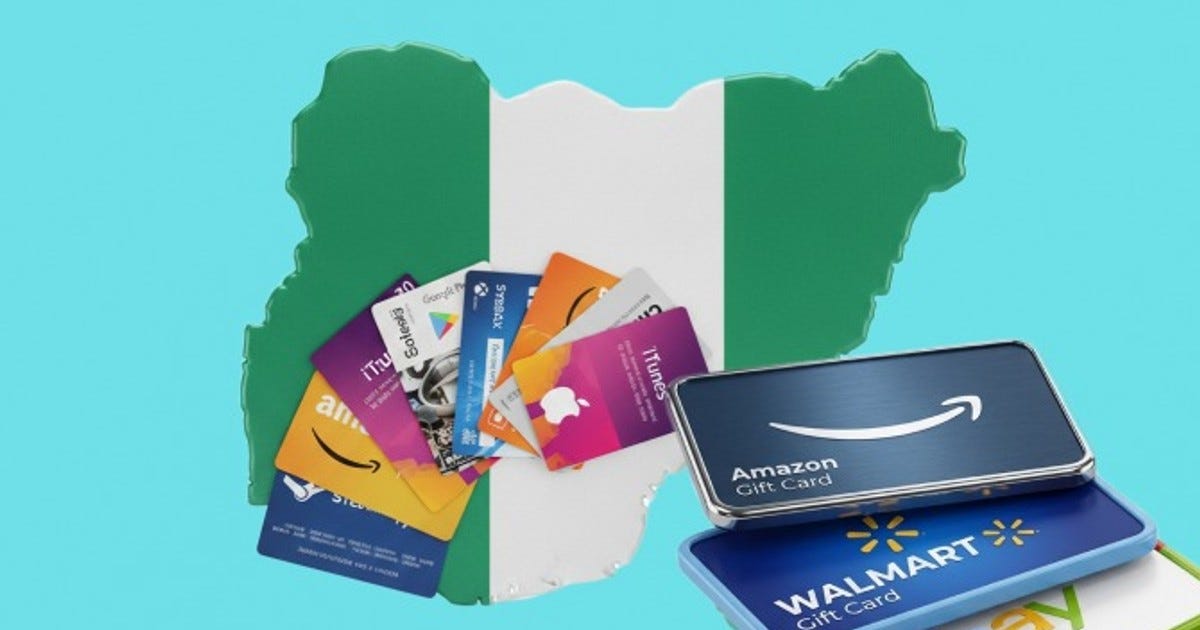
Cardron’s answer to all of them is the same interface. One WhatsApp number. Whatever you need.
The payment options are designed with the same logic. Some customers prefer bank transfer in naira. Others hold crypto and find it faster. Both work on Cardron. Ibrahim was deliberate about this, digital commerce in Africa has to meet people where they are, financially speaking, not where a platform would prefer them to be.
Trust is the part of this business that cannot be automated away, and Ibrahim knows it.
“A simple message saying ‘your code is on the way’ on WhatsApp does more than any big marketing we could do,” he said.
That is the insight that shapes how Cardron is built. Speed builds trust in digital commerce the way nothing else does, because speed removes the window in which doubt grows. Every code is verified before it is sent.
The system automatically detects failed orders and triggers alerts. If something does go wrong, a real person responds on the same WhatsApp chat, no support tickets, no email threads, no waiting.

The early customers reinforced this. They were not looking for the cheapest platform. They were looking for the one where the thing they paid for would actually arrive, confirmed, immediately. “People will pay extra just to not have to stress about whether their order is coming,” Ibrahim said. When that is what your customers tell you, you know exactly what to protect.
What those early users also did was expand the ambition.
They kept asking for more. eSIMs. Other access products. Things beyond gift cards. Ibrahim listened. Cardron now handles event ticketing too. Event organizers are already onboarded on the platform, selling digital tickets through the same WhatsApp flow.
That expansion revealed something important. The appetite is not specifically for gift cards, eSIMs or tickets. It is for a place where you can get any digital thing you need, fast, without the scam feeling that makes most of these transactions feel like a gamble.
“Cardron should be the platform Africans think of when they need something digital, and they want it to work,” Ibrahim said. “That’s the goal.”
Not a gift card seller. Not just a WhatsApp bot. The platform Africans trust with their digital needs, whatever form those needs take next.
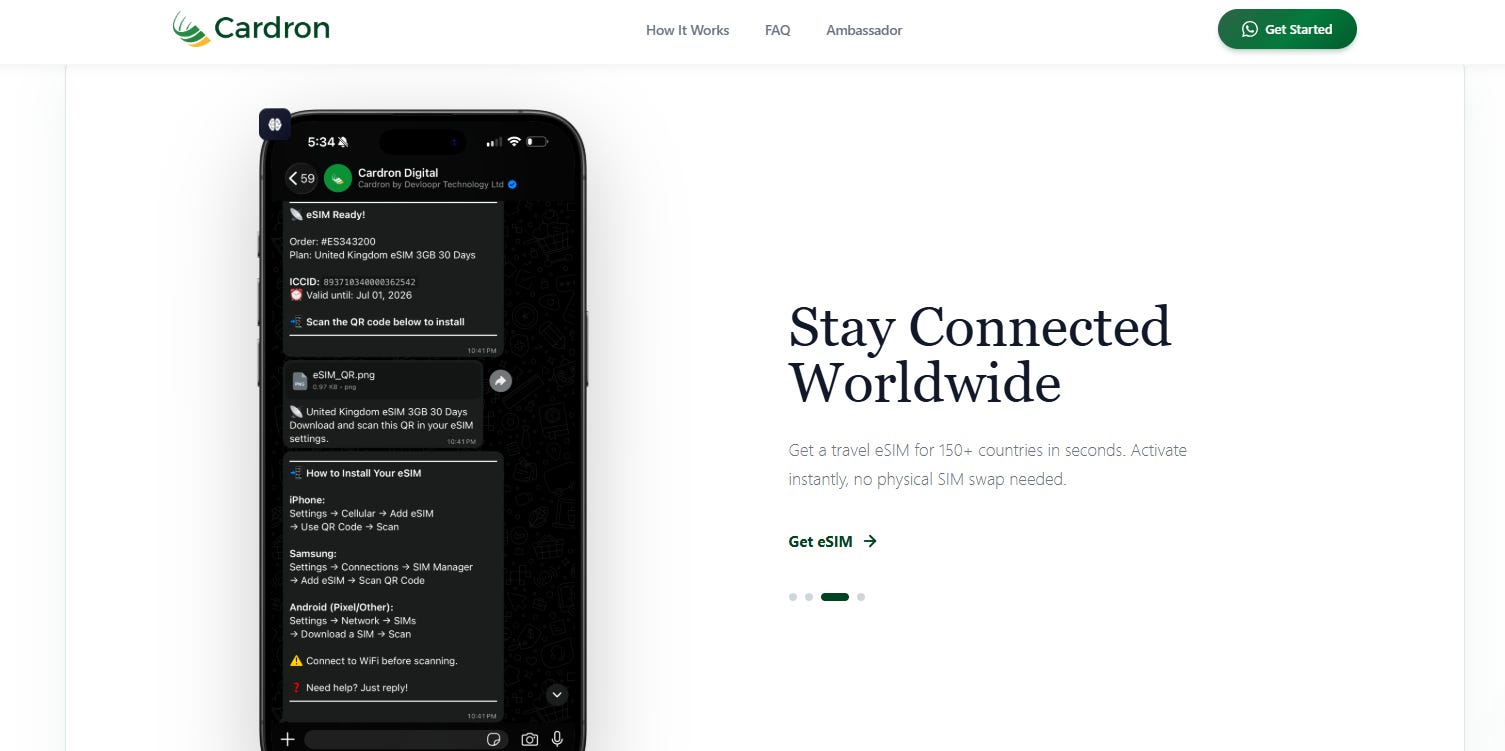
Ibrahim built the first version of that from Sheffield, watching a problem he knew from Nigeria, and deciding the best thing he could do about it was to make it go away.
So far, it is working.