

Building a website or software product is becoming easier as AI tools allow more people to turn ideas into working applications without writing every line of code themselves. But getting those applications online and keeping them running can still be a headache.
Developers need servers, databases, storage, domains and monitoring tools. They must also configure these services to work together. For experienced engineers, this can mean hours of technical work. For a first-time founder using AI to build a product, it can become the point where progress stops.
This is the problem Nigerian startup Brimble wants to solve.

Co-founded by Abraham Ugbeshe and a fellow software engineer and CTO, Muritala David, Brimble started as a tool that allowed developers to deploy applications built with Next.js without relying on Vercel, a popular platform for hosting web applications.
Today, the company is building a broader cloud platform that brings application deployment, databases, storage, domains and other infrastructure services into one place. It is also adding AI tools that allow users to build and deploy websites with simple instructions.
The startup says it has attracted more than 4,000 users and supported over 1,200 deployed applications. What began as a side project has grown into an attempt to make cloud infrastructure easier to use for developers and businesses around the world.
From a side project to a cloud startup
Brimble’s beginnings were not particularly different from those of many developer-led startups. Its founders wanted to build something together, but their first idea was a cryptocurrency-based platform for cross-border payments.
After exploring the idea, they decided not to pursue it. Both were already working as software engineers, building and managing products for clients. Abraham had a full-time engineering job, while his co-founder was freelancing.
Around that time, Next.js was gaining popularity among developers. However, deploying applications built with the framework outside Vercel could be difficult, particularly for developers who wanted to use its more advanced features.
The founders decided to build a command-line tool, or CLI, that would make the process easier. Initially, it was a solution to a problem they had encountered themselves.
When they shared the tool on X, formerly Twitter, the response surprised them. According to the founders, Brimble attracted about 1,000 sign-ups within its first three weeks.
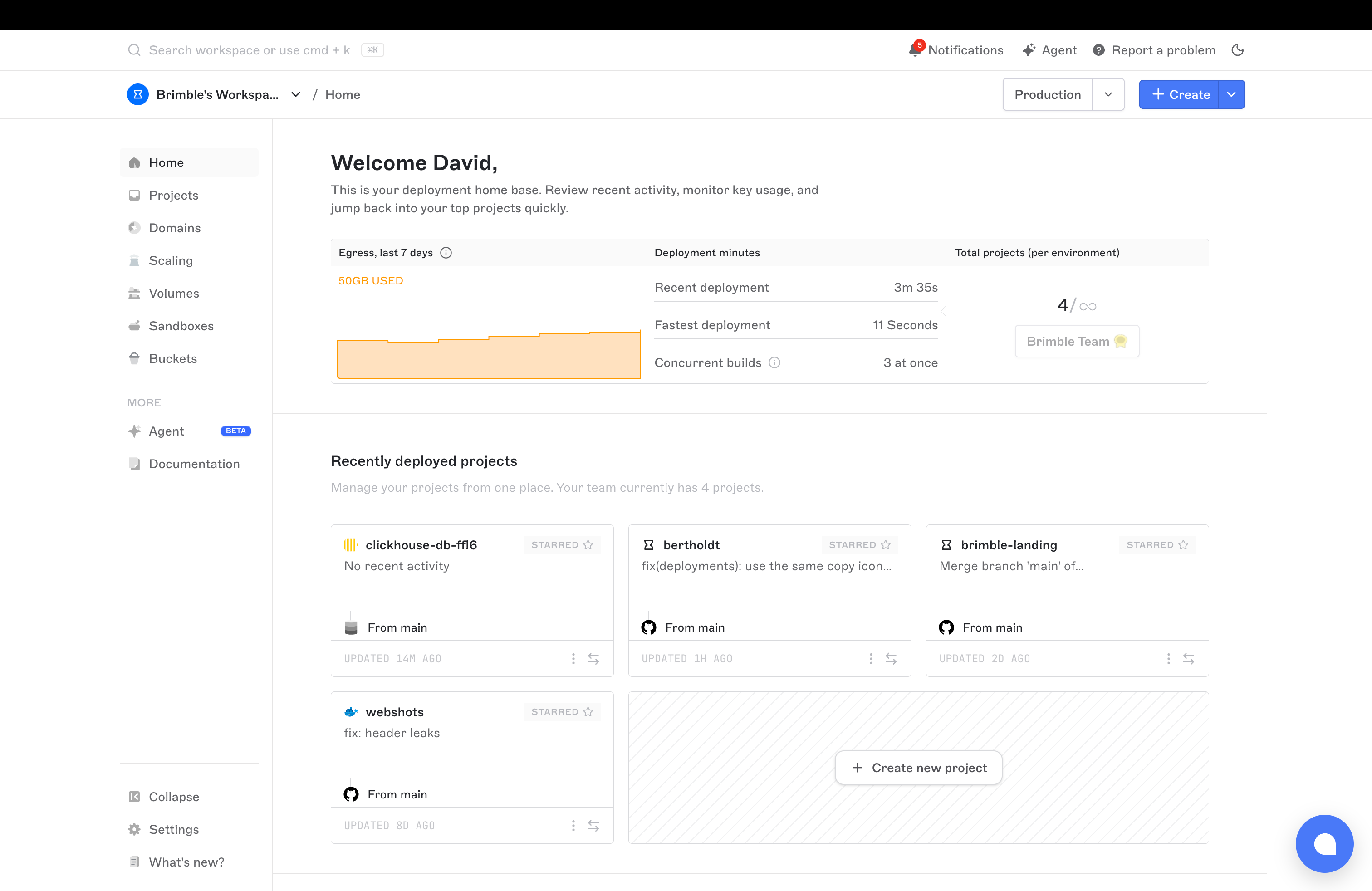
That early interest suggested the problem extended beyond the founders’ own projects. They began building a dashboard around the tool, giving users a more complete experience instead of requiring them to manage everything through the command line.
That was when Brimble began to take shape as a business.
Why AI is making cloud infrastructure more important
The rise of AI coding tools has changed who can build software. Products such as Cursor, Claude and Lovable allow people to create websites and applications with less manual coding.
But generating an application is only part of the process. It still needs somewhere to run, and developers must connect it to databases, configure its domain, manage access and make sure it remains available to users.
Brimble believes the gap between building software and running it is becoming a bigger problem as AI brings more people into software development.
“The easier software becomes to build, the more important it becomes to make that software easy to run,” the founders said.
That thinking informs Brimble’s push towards what it calls an AI-native cloud platform. Rather than simply adding a chatbot to an existing hosting service, the company wants AI to become part of how users create, deploy and manage applications.
For example, its AI-powered website-building tool allows users to describe a website they want, have an AI agent build it and deploy it on Brimble’s infrastructure.
The company has also developed a Model Context Protocol (MCP) server, which allows compatible AI tools to interact with Brimble directly. This means developers can use their preferred AI coding assistants to manage deployments and infrastructure without opening the Brimble dashboard for every task.
The wider goal is to bring the tools needed to run an application into one platform, reducing the amount of time developers spend connecting separate services.
More than 4,000 users, 1,200 applications
Brimble says it now has more than 4,000 users and over 1,200 deployed applications. Those applications range from personal projects and simple websites to production systems used by businesses.
The company has seen adoption from startups in sectors including fintech, healthcare and online marketplaces, where applications may support customer transactions and everyday operations.
The growth has also changed what users expect from the platform.
Brimble initially focused on deployment, helping developers get applications online without unnecessary technical work. As more people began using the service, their needs expanded to databases, storage, monitoring, logs and tools for troubleshooting problems.
The founders say customer feedback has helped shape the product roadmap, pushing the company to address more of the work involved in running software after it has been deployed.
“The biggest lesson has been that developers don’t necessarily want more infrastructure tools. They want fewer things to worry about,” they said.

It is a distinction that matters in a market where cloud providers offer a growing range of services. Developers may have access to powerful infrastructure, but managing that infrastructure can become a job of its own.
Brimble is betting that many developers and smaller businesses would rather spend their time improving their products than maintaining the systems behind them.
Building cloud infrastructure from Nigeria
While Brimble is targeting a global market, it is also expanding its infrastructure footprint in Nigeria.
The company initially launched with infrastructure in Europe before beginning to expand into other regions, including Lagos. It says it has been placing greater emphasis on local infrastructure since the beginning of 2026, with the aim of serving Nigerian businesses closer to their customers.
Local hosting can be particularly relevant for businesses handling sensitive information or operating in regulated sectors. Data protection, data residency and compliance requirements can influence where businesses choose to host their applications and how they manage customer information.
Brimble says it has started preparing for relevant requirements under the Nigeria Data Protection Commission (NDPC) and for SOC 2 compliance. These are steps towards meeting the expectations of businesses that need stronger assurances around how their systems and data are handled; they should not be confused with having already received those certifications or attestations.
Building a cloud platform across different regions also involves more than renting servers. The company must manage the systems that schedule applications, route traffic, provide storage, monitor services and keep everything working consistently.

Local infrastructure presents its own challenges, including the availability of suitable data centre capacity. Brimble says it has begun discussions with providers in Lagos and Abuja about running its infrastructure layer on their physical computing resources. It is also exploring the possibility of owning physical hardware in the coming year.
These plans could give the company greater control over its infrastructure as it expands in Nigeria, although their success will depend on execution, reliability and the cost of operating across multiple locations.
Competing with global cloud providers
Brimble is entering a market dominated by established players such as Amazon Web Services (AWS), Google Cloud and Microsoft Azure. These companies provide extensive infrastructure and services, making them difficult competitors for a young startup.
But Brimble is not trying to reproduce everything the major cloud providers offer. Its approach is to focus on the services developers commonly need and make them easier to manage from one place.
A developer should be able to deploy an application, connect a database, configure storage, manage domains and monitor services without spending days learning how different systems fit together.
The company also sees an opportunity to serve African businesses that want infrastructure closer to their users, alongside a simpler developer experience.
Still, being built in Nigeria is not, on its own, a reason for customers to choose Brimble. The company will need to demonstrate that its platform is reliable, secure and capable of supporting applications as they grow.
Its early user numbers suggest there is interest in the product. Turning that interest into long-term usage, particularly among businesses running critical applications, will be an important test as the platform expands.
A bootstrapped bet on a global market
One notable part of Brimble’s story is how it has funded its growth. The founders say they have bootstrapped the company for the past three years, building the platform and growing its user base without raising external capital.
That approach has allowed them to develop the business using their own resources, but expanding a cloud platform across more regions will require continued investment in infrastructure, reliability, product development and customer acquisition.
Over the next two to three years, Brimble wants to expand its infrastructure footprint, add more services and reach developers in more markets. The company also expects to compete more directly with local cloud providers as its capabilities grow.
For the founders, success will mean building a platform that developers can trust to run important parts of their businesses, regardless of where those businesses are based.
“We want to demonstrate that a globally competitive infrastructure company can be built from Africa, serve customers everywhere, and compete on product quality rather than geography,” they said.
That ambition is bigger than making deployment easier. Brimble wants to become part of the infrastructure developers rely on as they build and grow their products.
Whether it can get there will depend on more than making cloud tools simpler. It will need to keep applications running reliably, earn the trust of businesses and compete on performance and value in a market where customers already have plenty of options.

But as AI makes software creation accessible to more people, the infrastructure required to run that software could become an increasingly important opportunity. Brimble is building for that possibility, from Nigeria, with a product it hopes developers around the world will have a reason to choose.