


Every Nigerian reading this has been there. You are far from home, somewhere busy, a market, a bus stop, a commercial street, and nature calls. You look around. Nothing. You walk. You ask. You get vague directions. You find something eventually, but you wish you had known earlier, planned better, or had somewhere to look it up.
Adetokunbo Ogunnoiki lived this problem so deeply as a mathematics student at the University of Ibadan that he built his own solution, mentally, first. The hostel toilets were so bad he refused to use them.

So he mapped his surroundings instead. He knew which departmental toilets were open, which nearby banks had decent facilities, and at what hours.
That mental map, over time, became a question: why hasn’t anyone built this?
The answer is LooPoint
.
What is LooPoint, exactly?
LooPoint is a browser-based geo-mapping platform that helps users find clean, available public toilets in real time. No app download required, users simply visit the site or scan a QR code on any basic smartphone. The platform shows cleanliness ratings, walking directions, and estimated arrival times.
It sounds simple. That is the point. The best civic technology solves problems so obvious, so universal, and so embarrassingly unaddressed that the moment you see it, you wonder why it didn’t exist before.
“Where I stay in Lagos, you can hardly find a public toilet at major bus stops or market areas. The toilets are there, but you can hardly find them. And even if you do, they are not as comfortable as you would want.”
— Adetokunbo Ogunnoiki, Founder, LooPoint
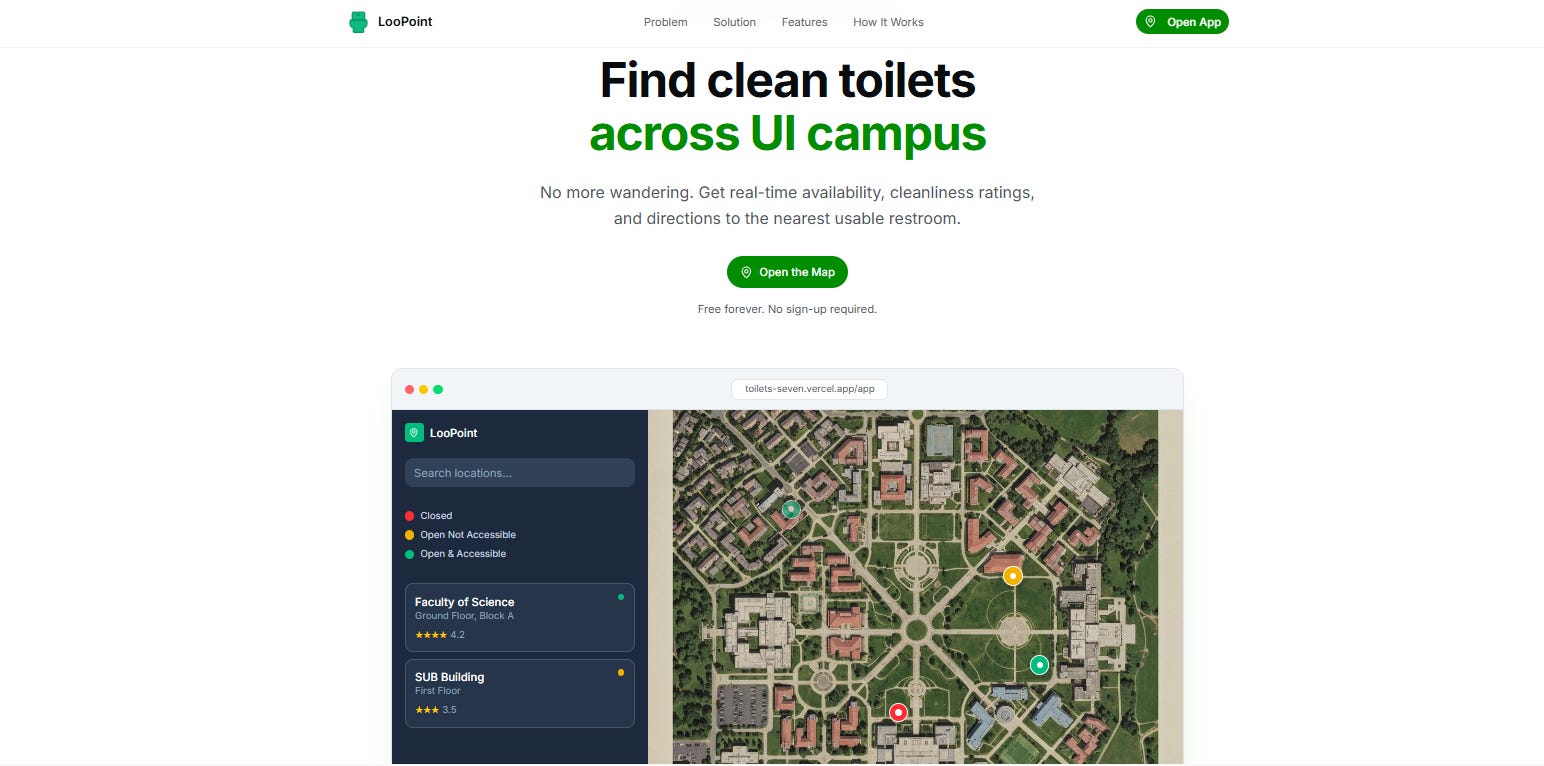
Ogunnoiki built the entire platform, front end and back end himself, launching at UI in mid-2025. The problem he was solving, he quickly realized, was bigger than one campus. It was Lagos. It was Nigeria. It was the entire continent.
The gap nobody was filling
Toilet-finder apps exist in the world. But check the App Store and you’ll find something telling: virtually none of them cover Africa in any meaningful way.
The continent, with its dense urban centers, its millions of daily commuters, its market women navigating Oshodi and Idumota and Lagos Island, is invisible to the global sanitation tech map.
LooPoint is changing that. And the design philosophy matters here: by running entirely through a browser, the platform removes the single biggest barrier to adoption in emerging markets, the need to download yet another app.
If you have a smartphone that can open a browser, you can use LooPoint. That is nearly everyone.
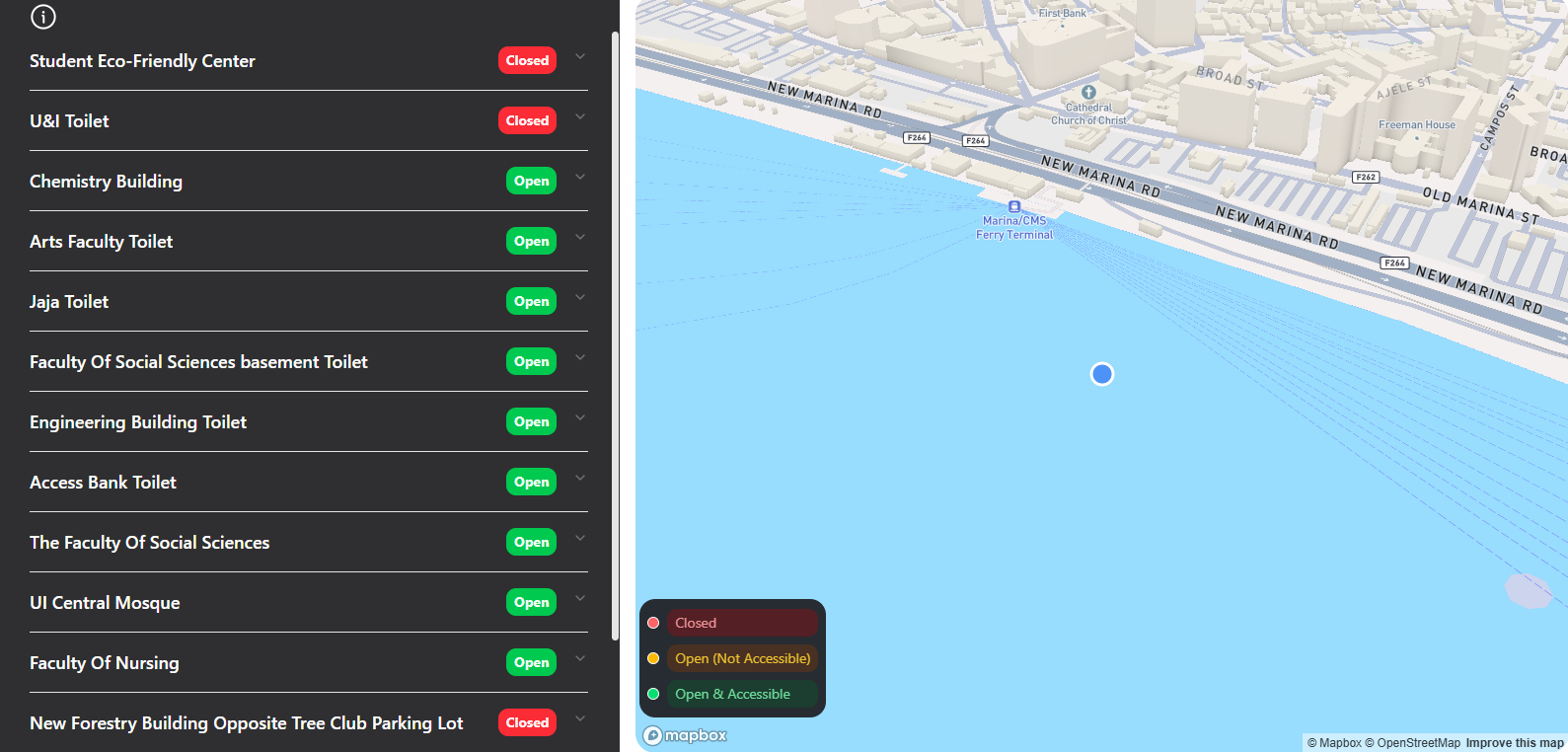
Nigeria's public toilets are not missing. They are just invisible. LooPoint gives them an address.
The X post that changed everything
For a while, LooPoint faced the question that quietly kills many utility startups: who pays for this? The team, Ogunnoiki and his co-founder Ademola Gbadero, wrestled with the revenue model and even considered shutting down.
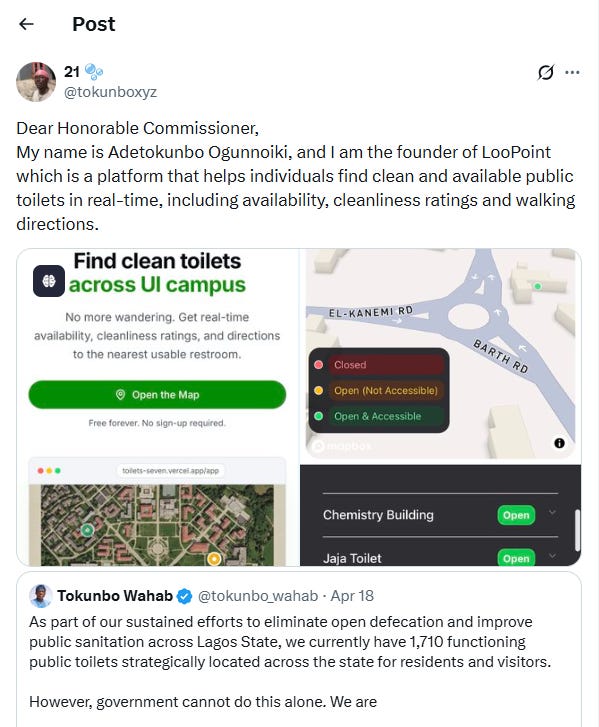
Then Ogunnoiki posted about the idea on X.
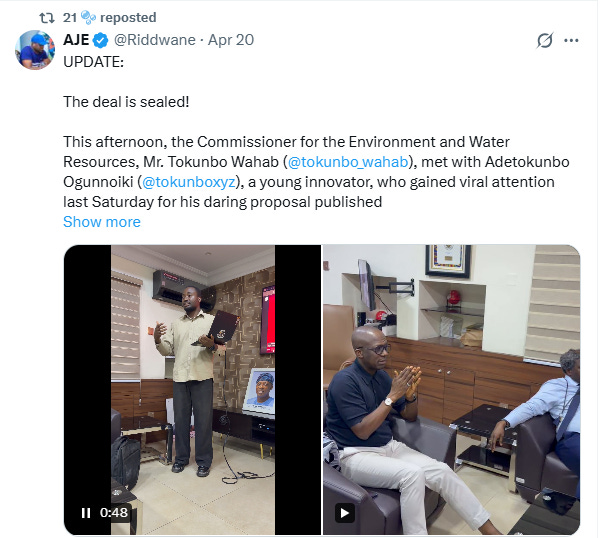
That post reached Tokunbo Wahab, Lagos State’s Commissioner for Environment and Water Resources. He didn’t just like the idea, he invited the founders to his office. In the room: the Special Adviser to the Governor on e-GIS and the Director of Sanitation Services. LooPoint pitched. The Commissioner approved on the spot and requested a full budget for a follow-up.
“Meeting with somebody of that calibre and pitching somebody of that calibre, and then them saying, ‘Let’s come to the office and hear more’, was really, really exciting. It just validated everything I had always believed.”
— Adetokunbo Ogunnoiki
That meeting produced LooPoint's first major commercial contract. Lagos State will work with the startup to map newly provided public toilets across the state, as well as schools, businesses, and government buildings willing to open their facilities to the public. The government also plans to run publicity at launch.
Why the business model is smarter than it looks
Here is what makes LooPoint genuinely clever beyond the product itself: the revenue model does not require charging users at all. State governments and institutions pay to have their facilities mapped and found.
Individual users access the platform free. This preserves the accessibility that makes LooPoint useful while building a sustainable B2G and B2B revenue stream.
The team is already in conversations with contacts in Oyo State and the FCT. The ambition is every state in Nigeria, and eventually, the continent.
“LooPoint is not just going to be Lagos-based. You can literally go anywhere in Nigeria and be able to find a toilet.”
— Adetokunbo Ogunnoiki
Why this story matters
LooPoint is not a glamorous startup. It will not trend at a Silicon Valley conference. Nobody is writing breathless think-pieces about it in San Francisco. But it is solving a real problem, for real people, in the real cities where millions of Nigerians live and work every single day.
That is exactly the kind of builder in60 exists to spotlight. Adetokunbo Ogunnoiki started with a bad university hostel and a mental map. He ended up in a room with a Lagos State Commissioner, contract in hand, with eyes on the whole country.
If you are a foreigner visiting Nigeria, or just someone navigating Lagos on a long day, LooPoint will find you a toilet. But more than that, it is proof that the most powerful ideas are often the ones hiding in plain sight, waiting for someone brave enough to build them.
Follow LooPoint's journey. Their public launch is coming soon. If you're building something in civic tech, public health, or urban infrastructure across Africa, I want to hear from you.
Don’t forget to share and subscribe to get all the great stories coming out of African tech. 📩 in60spotlight@gmail.com
Bankole Mubarak, Head of Newsletter · In60 · Telling the stories that matter.