In Yorubaland, sọ̀wọ́ evokes the act of doing business, making a sale, and getting things moving. It is an apt name for a startup trying to solve a problem familiar to anyone who has ever sold something online in Nigeria: getting customers is one thing; keeping up with them is another.
Imagine a restaurant in Lagos on a busy afternoon. One customer wants to see the menu on WhatsApp. Another is asking whether payment has gone through. Someone else wants an update on an order, while a new customer is ready to buy but has not received a response.

The food is cooking. Deliveries need to leave. More messages are arriving. And somewhere between the notifications, a sale could slip away.
For many Nigerian businesses, WhatsApp and Instagram have become storefronts, sales desks and customer service centres. But the more customers they attract, the harder it can become to manage orders and conversations manually.
That is the problem SOWO, which just launched on October 1, wants to tackle.
Founded by Ifeoluwa Oyeyemi, Korede Oyeyemi and Paul Uwaifo, the startup is building a platform that connects customer conversations with the work required to complete a sale: managing orders, handling payments, tracking deliveries and keeping customer information organised.
Ifeoluwa, who enjoys the business of attracting customers and turning their interest into sales, said the idea came from observing how Nigerian businesses were already selling online.
“I’ve always been interested in what helps a business attract customers, convert that interest into sales, and keep those customers coming back,” he told in60.
He noticed that many businesses had figured out how to attract attention on social media. The trouble often started when customers began asking questions, placing orders, and requesting updates, all through conversations the owner had to manage.
As the business grew, so did the risk of missing messages, losing sales, and disappointing customers.
SOWO emerged from a simple question: what if technology could help businesses manage that entire customer journey?
From the DM to the doorstep
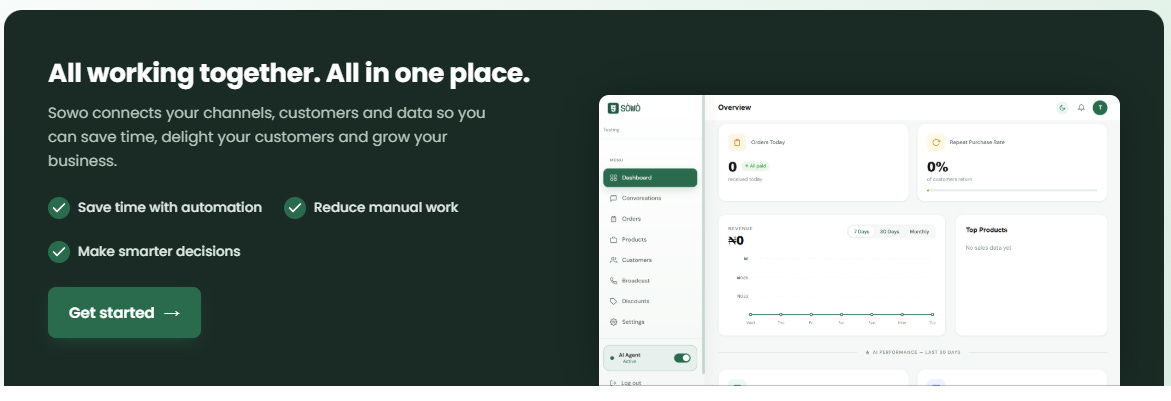
SOWO is designed to bring several parts of selling into one organized workflow. Its platform connects messaging, customer information, order management, payments, and delivery tracking, using automation to reduce repetitive tasks.
Rather than asking a restaurant owner to search through chats to confirm an order or work out which customer still needs a response, the aim is to make that information easier to manage.
The platform also uses AI-assisted conversations and automated replies. Routine interactions can be handled more efficiently, while complaints, unusual requests and sensitive issues may still need a human touch.
That distinction matters. A customer asking for a menu may need a quick response; someone whose order has arrived late needs a business that can listen, investigate, and resolve the problem.
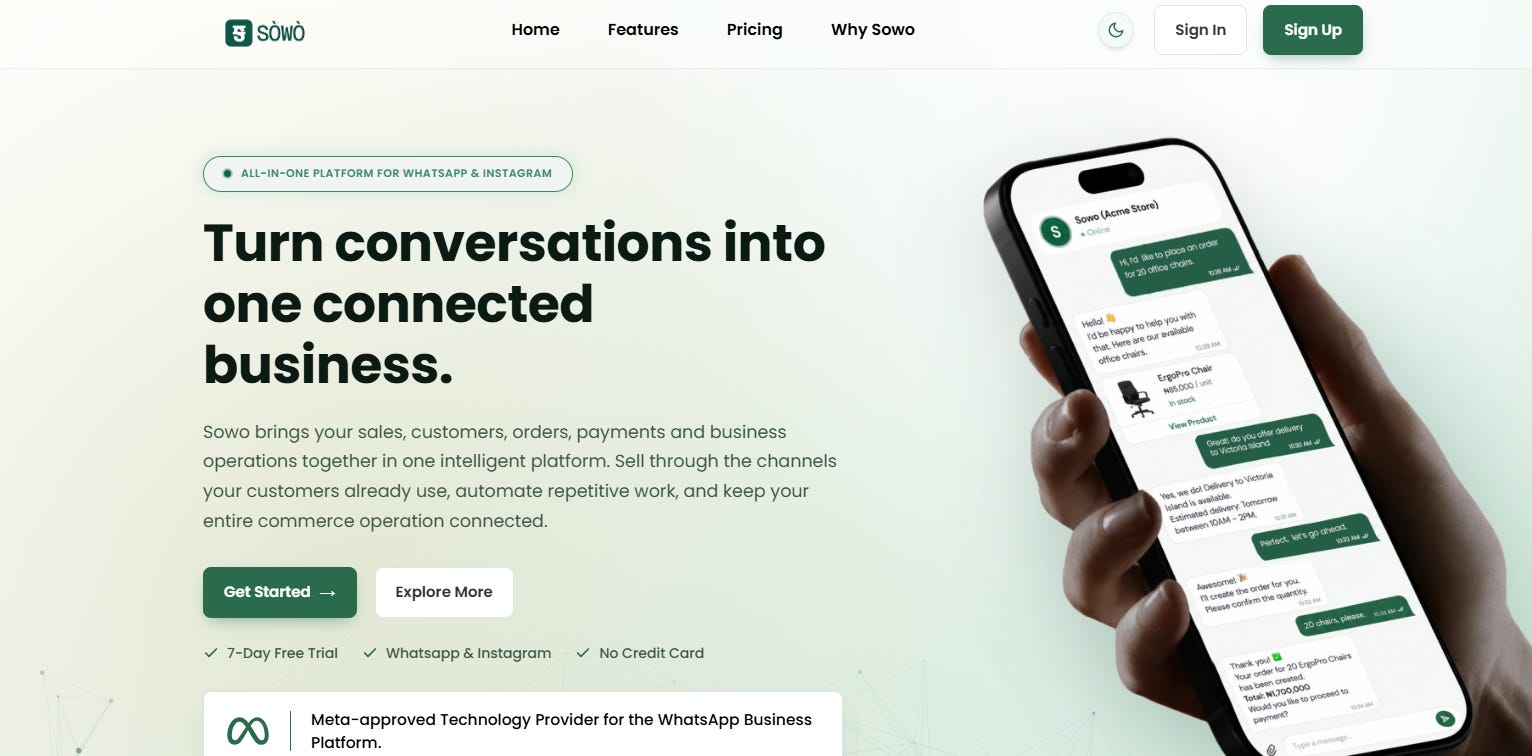
SOWO also has a live Paystack integration and delivery-tracking capabilities, connecting payment and fulfilment to the customer journey. The technology cannot guarantee that every order arrives on time, but it can help businesses keep better track of what has happened and what still needs attention.
The founders are building around WhatsApp and Instagram because they believe businesses should not have to abandon the platforms their customers already use.
These channels are not merely places to advertise products. For many sellers, they are where trust is established, questions are answered, and purchasing decisions happen.
Why restaurants come first
Although SOWO’s longer-term ambition is to support businesses that sell through digital conversations, its immediate focus is restaurants in Nigeria.
Restaurants have to coordinate customer requests, orders, payments, and delivery, sometimes across several locations. When WhatsApp is an important source of revenue, losing track of a conversation can mean more than an untidy inbox; it can mean losing an order.
SOWO is already working with a restaurant business operating across multiple locations in Lagos. According to Ifeoluwa, WhatsApp orders are an important revenue driver for the business, and the platform is helping streamline its workflows.
The early feedback has been positive, but the founders do not yet have verified figures showing how much SOWO has increased sales or reduced lost orders. They want to measure outcomes such as the number of enquiries that become paid orders, repeat purchases, and time saved.
That evidence will matter. Helping a restaurant organize its operations is a starting point; proving that the change improves its business is a bigger milestone.
SOWO’s technology ecosystem includes a live Paystack integration and access to Meta’s technology ecosystem, according to the founders. These are relevant steps in building around existing platforms, though technical access and integrations should not be confused with formal endorsements by those companies.
What does it cost to do business with SOWO?
SOWO offers a seven-day free trial without requiring a credit card. After that, businesses can choose from three plans.
Basic: ₦5,000 monthly or ₦48,000 annually. It includes WhatsApp connection, unlimited AI-powered automated replies, payment confirmation, dashboard analytics, and a catalogue of up to 20 products.
Growth: ₦20,000 monthly or ₦192,000 annually. It adds unlimited products, Instagram connection, customer management, purchase history, broadcasts, promotions, order fulfilment and tracking.
Business: Custom pricing for businesses needing tailored integrations, dedicated support, and features for more complex operations.
The plans give restaurants options as their needs grow. But for a small business watching every naira, the important question is whether the platform saves enough time, helps recover enough sales or improves customer service enough to justify the subscription.
That is something SOWO still needs to demonstrate as it grows.
Two paying customers, one big ambition
SOWO is barely a month old. Since launching on October 1, it has secured two confirmed paying restaurant customers, whose operations span multiple locations in Lagos.
It is an early start, not proof of widespread adoption. But those customers allow the team to learn from real businesses, improve the product, and understand what restaurant operators actually need.
The challenge is translating a promising idea into something businesses can depend on every day. Customer conversations are unpredictable, operational processes differ, and owners need to trust a new system with relationships they have worked hard to build.
For Ifeoluwa and his co-founders, the ambition is to help business owners spend less time chasing information and more time growing what they have built.
That means moving beyond simply answering messages. It means helping businesses attract customers, turn interest into sales, and give people reasons to return.
The Yoruba-inspired name captures the spirit of that ambition: sọ̀wọ́ — do business. But doing business successfully takes more than finding customers. It takes a way to serve them, fulfil their orders and keep them coming back.
SOWO has identified a problem that many Nigerian businesses will recognise. Its next task is to prove that its technology can solve it consistently, one order and one customer at a time.