Let’s talk about something every Nigerian with a dollar transaction has done.
You need to buy USDT. Or sell it. Or send money abroad. Or receive a payment from a client in the UK. So you open Binance. Check the rate. Open Bybit. Check again. Someone in a WhatsApp group says Quidax is better today. You open Quidax.
Meanwhile, the rate on Binance has moved. You go back. You are now six apps deep, five minutes have passed, and you still do not know with any confidence where the best rate actually is.

In 2023, Jeremy Ikwuje and Olayinka Omoniyi were sitting with that exact problem and doing what software engineers do when something is clearly broken: they started building the fix.
“There wasn’t a single reliable view you could track USDT to naira rates across popular exchanges,” Olayinka told in60. “If you tried, you were jumping from app to app and there were literally no open APIs.”
So they built Monierate. And then 10 million page views later, they are still building it.
What Monierate actually is
Monierate is a currency data aggregator. In plain terms: it is the platform that pulls FX rates from across African fintechs, crypto exchanges, neobanks, and currency platforms and puts them all in one place so you can compare them in seconds instead of hours.
You visit monierate.com, and you get a live table showing what USDT is trading at across Binance, Bybit, Quidax, Bitnob, Grey, ChipperCash, Luno, and dozens of other providers, all at once, all in real time.
No toggling. No WhatsApp messages to currency peddlers. No guessing. Just the market, displayed honestly, side by side.
Jeremy brought the engineering: he had worked as a backend engineer on multiple stablecoin and fintech apps and had the network to get API access from the ground up.
Olayinka was at Convexity, which gave them further reach into the ecosystem. Between them, they had exactly what this kind of platform required: the technical ability to build it and the industry relationships to feed it with real data.
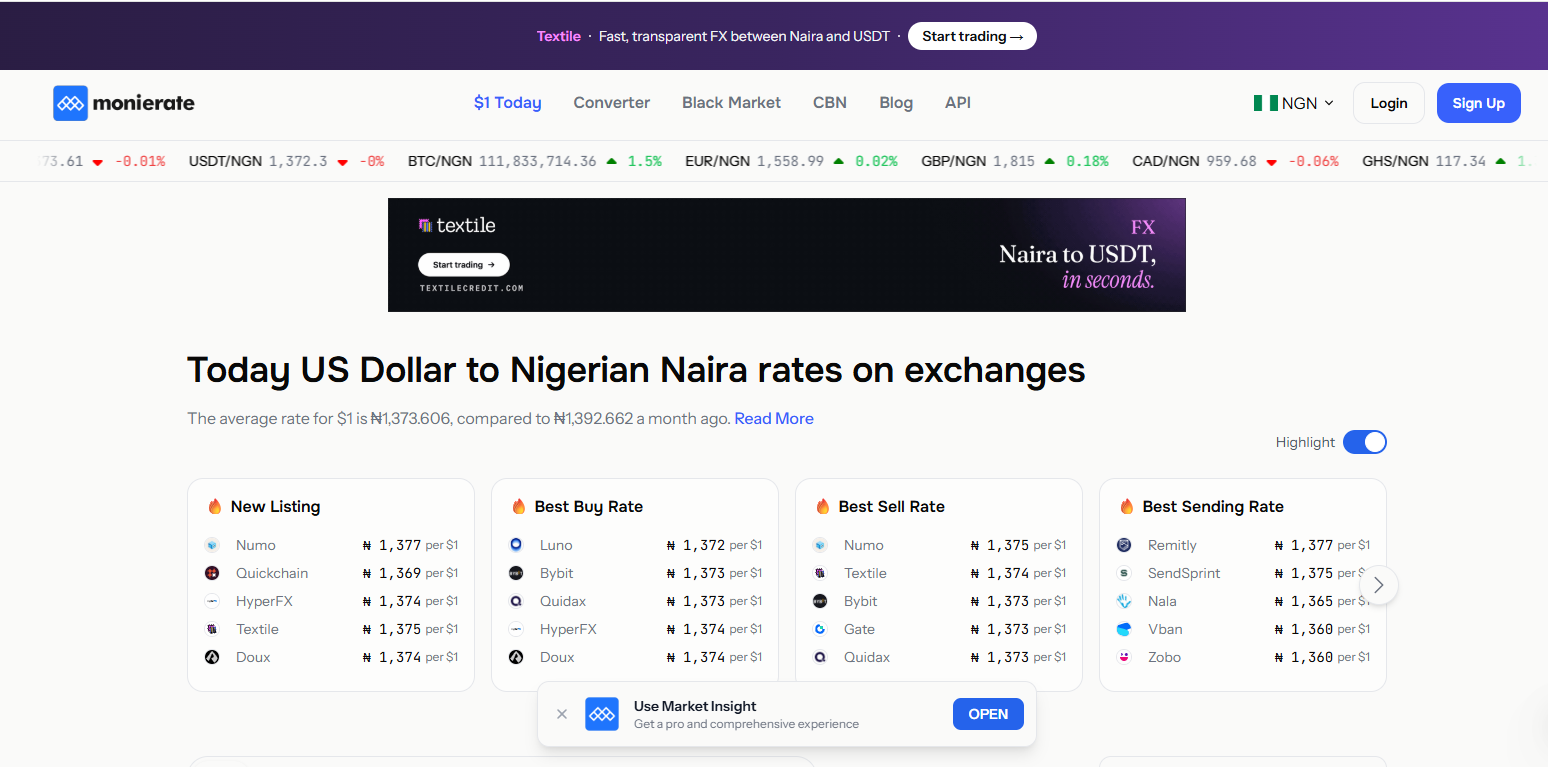
The rate gap you didn’t know was bleeding you
When Monierate launched, you could find dollar rates up to ₦130 cheaper on some providers compared to what ChipperCash and similar premium fintechs were quoting. Not ₦2. Not ₦10. ₦130 per dollar.
On a $100 transaction, that is the difference between paying ₦147,000 and paying ₦137,000.
On $1,000, that gap becomes ₦100,000. Gone. Just because you did not compare.
“The difference can be as low as ₦2 and as high as ₦160,” Olayinka said.
For someone exchanging serious volume: a business, a trader, a remittance operator processing hundreds of transactions monthly, that difference compounds into something that would make any CFO wince.
The good news is that competition is working. Premium fintechs like ChipperCash, Eversend, and Luno have made significant rate adjustments since Monierate launched, partly because transparency creates pressure. When users can see the spread between providers in real time, the expensive ones have to respond.
That is exactly what market transparency is supposed to do.
How they actually get the data
This part is genuinely interesting and worth explaining because it shows how much work goes into something that looks simple on the surface.
Monierate works directly with most of the providers on the platform. The focus is on liquid providers, ones where the rate being quoted is actually tradable, not a theoretical number. Because if a user makes a decision based on a rate that cannot actually be executed, the whole thing is useless.
Some providers give Monierate direct API access. Some share their rate data through Google Sheets. Yes, literally a Google Sheet, via Google Scripts. And some Monierate built scrapers for pulling rates directly from their websites.
“To tell you the level of access — some we even get their rate data from their Google Sheet via Google Scripts,” Jeremy said.

That patchwork of integrations is unglamorous and technical and completely invisible to the person checking a rate on their lunch break. It is also exactly what makes the product work. You do not build reliable real-time FX data aggregation by waiting for the market to hand you clean APIs. You build it by solving every integration problem one by one.
Monierate now covers over 90 sources across the African exchange market, including recent additions like Textile, Gate Exchange, MavaPay, Zobo, Vban, Karsa, and Doux Finance. Corridors now covered include NGN, KES, GHS, ZAR, and BRZ.
Who is using it and what the numbers look like
In the first week Monierate launched, it had about 1,200 visits. Twelve months later, it was doing over 200,000 monthly visits. Today, the platform averages between 70,000 and 145,000 monthly visits depending on market conditions.
That last part is telling. The single highest traffic day in Monierate’s history was 21,000 visits, the day USDT to naira hit ₦1,700 in 2024. When the naira moves, Nigerians run to Monierate to figure out what is actually happening. That is the clearest possible signal of what the platform has become: not just a comparison tool, but a market reference point.
Over 10 million page views across three years. Over 400,000 API data requests in the last six months alone.
On the API side, where Monierate is seeing its sharpest growth, the users are fintechs, trading firms, VC firms, and e-commerce platforms. Names like Quidax, Bitnob, BoldSwitch, Spenda, Cedar, and Shiga are all pulling Monierate’s data to power their own products.
When a fintech needs a reliable, real-time reference rate for Nigerian FX, Monierate is increasingly where they go.
On the consumer side, the users are OTC traders, international merchants, remittance operators, research students, and ordinary Nigerians who want to know the real rate before making a move.
The bigger problem they are actually solving
Here is where Monierate’s vision extends beyond a comparison table.
Ask Google what the naira to Ethiopian Birr rate is, and it will tell you something like 8.13. That number is not exactly wrong; it is just completely useless.
Because when a Nigerian named Tayo is actually travelling to Ethiopia or sending money there, nobody will give him that rate. He has to message a currency peddler on WhatsApp. He gets quoted something closer to ₦14, almost double what Google showed him. And he has no choice because there is no platform to discover the real market rate.
That scenario plays out across dozens of African currency pairs. Egypt. Ethiopia. Kenya. Countries where official rates and real trading rates exist in completely different universes.
“Currency price data in Africa is unstructured,” Jeremy said. “There are a lot of markets.”
Monierate is working to change that by building structured FX data across African and Asian currencies, accessible as JSON and CSV, through a web portal, and through mobile.
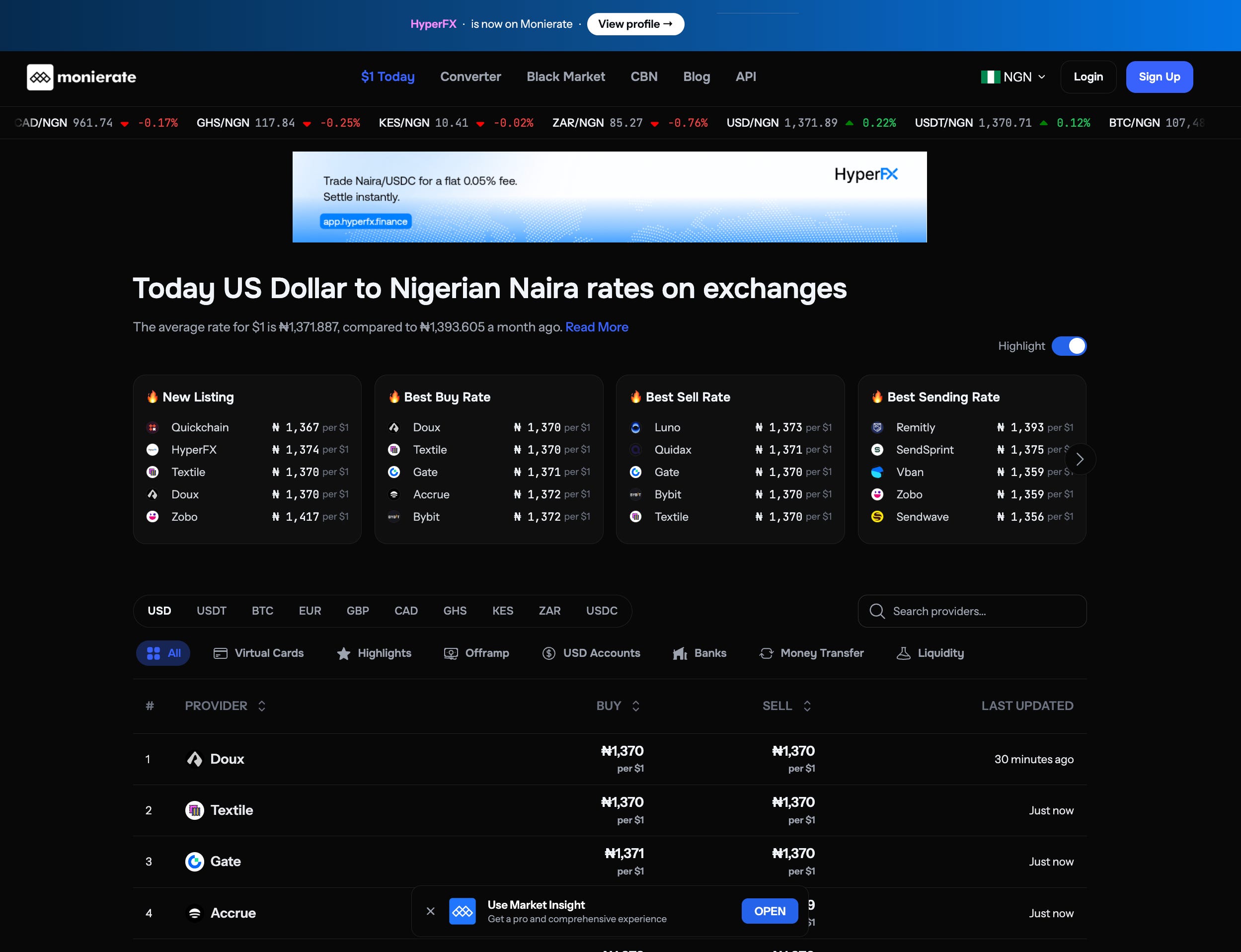
The Intelligence Dashboard gives businesses and treasury teams a comprehensive view of rate movements, spreads, and market dynamics that was previously only available to institutions with expensive Bloomberg terminals or informal WhatsApp networks.
The business model
Monierate operates a usage and subscription API billing model. There is a pay-per-call plan starting at ₦10 per request, low enough that individual developers and small fintechs can access the data without a large upfront commitment. Pro and Max subscription plans serve higher-volume users. Brand partnerships and promotions add a second revenue layer.
The model is built around a simple truth: the more the market needs reliable FX data, the more valuable Monierate’s infrastructure becomes. And as African cross-border commerce, remittances, and stablecoin usage all continue to grow, that need is only going in one direction.
Olayinka described the goal as simply as it can be stated.
“Our goal has always been to be a transparent and independent source of truth across supported currencies. Every provider we add makes the market a little more transparent for the businesses that depend on accurate pricing.”
The naira rate is one of the most watched numbers in Nigeria. For years, knowing the real rate, not the official rate, not the WhatsApp peddler rate, but the actual live market rate across every platform where it trades, required either expensive institutional access or a lot of manual work.
Jeremy and Olayinka built the shortcut. 10 million page views later, it turns out to be what a lot of people needed.