There's a certain group chat almost every Nigerian with family abroad has been in at some point in their life.
Someone announces they are flying home. Within minutes, the requests start coming in. A bag of chin chin from a specific brand in Lagos. A fabric that only exists in Balogun market. Asoebi that needs to make it to Houston before a wedding on Saturday. Baby food that is not sold anywhere in the UK.
A phone that costs twice as much if ordered internationally, and the traveller just trying to get from one city to another, has become a one-person logistics operation for everyone they know.
And on the other side of that group chat are the people who didn't know anyone flying at the right time. The ones who missed the window. Whose item sat in a Lagos shop for weeks because no one they knew was heading to Toronto. Who paid a courier more than the item was worth, gave up entirely, or asked a stranger on Twitter and hoped for the best.
Samuel Ayokanmbi, Adebanjo “BJ” Adesoye, and Seyebomi “Sheye Banks” Ogunsanya have been on both sides of this story. Multiple times. Across multiple cities. Over many years.
They did not build Pikkah because they spotted a market opportunity on a spreadsheet. They built it because they lived the frustration long enough to know exactly what the solution needed to feel like.
The clothes that almost missed the wedding
Sam knows the problem from Toronto, where he leads operations and strategy at Pikkah. His job is making sure the marketplace actually works: traveller verification, the mechanics of a carry, the arrangements and handovers that decide whether a delivery completes properly.
He also sets the commercial direction: where Pikkah grows next, which partnerships open those markets, and the legal and fundraising work that supports the vision.
But before any of that, he was just a Nigerian in Toronto trying to get things home.

He once paid courier charges that cost more than the item being sent. That alone should tell you everything about the gap in the market. But the story that has stayed with him, the one that captures what Pikkah is really about, is simpler and more human than any transaction.
He needed clothes made in Lagos for a wedding in Toronto. The clothes were ready. They were beautiful. Getting them from one city to the other became one of the most stressful parts of what should have been a joyful occasion.
“When something is tied to an occasion like that,” the team said, “its value is not just what is written on the receipt.”
That line says it all. Logistics platforms look at an item and see weight and dimensions. The person sending it sees something else entirely. The fabric your mother picked out. The outfit you’ll wear the first time you see your family in two years. The food from that one shop back home that just doesn’t taste the same anywhere else.
Pikkah came out of that gap, between what a package weighs on a scale and what it weighs to the person waiting for it.
The team behind it
Three people built this. Each one brings something the others do not have, and that combination is not accidental.
BJ is a product leader based in the United States with over a decade of experience across Nigeria, the UK, and the US, spanning startups and Big Four consulting, including work with major global financial institutions.
At Pikkah, he leads product strategy and technical delivery, working with engineering to turn customer needs into the shopping, matching, payment, and trust experiences people actually use.
Living abroad keeps the problem personal for BJ in a way that no amount of research could replicate. He knows the requests. He knows the favours. He knows the uncertainty of depending on someone else’s travel plans just to get something basic from one place to another.
“He wants to build a product people can use with confidence when asking someone they know is no longer an option,” the team said.
Then there is Sheye Banks, broadcaster, media entrepreneur, and the third co-founder, based in Lagos. With over a decade across radio, live entertainment, artist development, and brand partnerships, Sheye built a career around something deceptively difficult: making people feel understood quickly, and giving them a reason to trust something new.
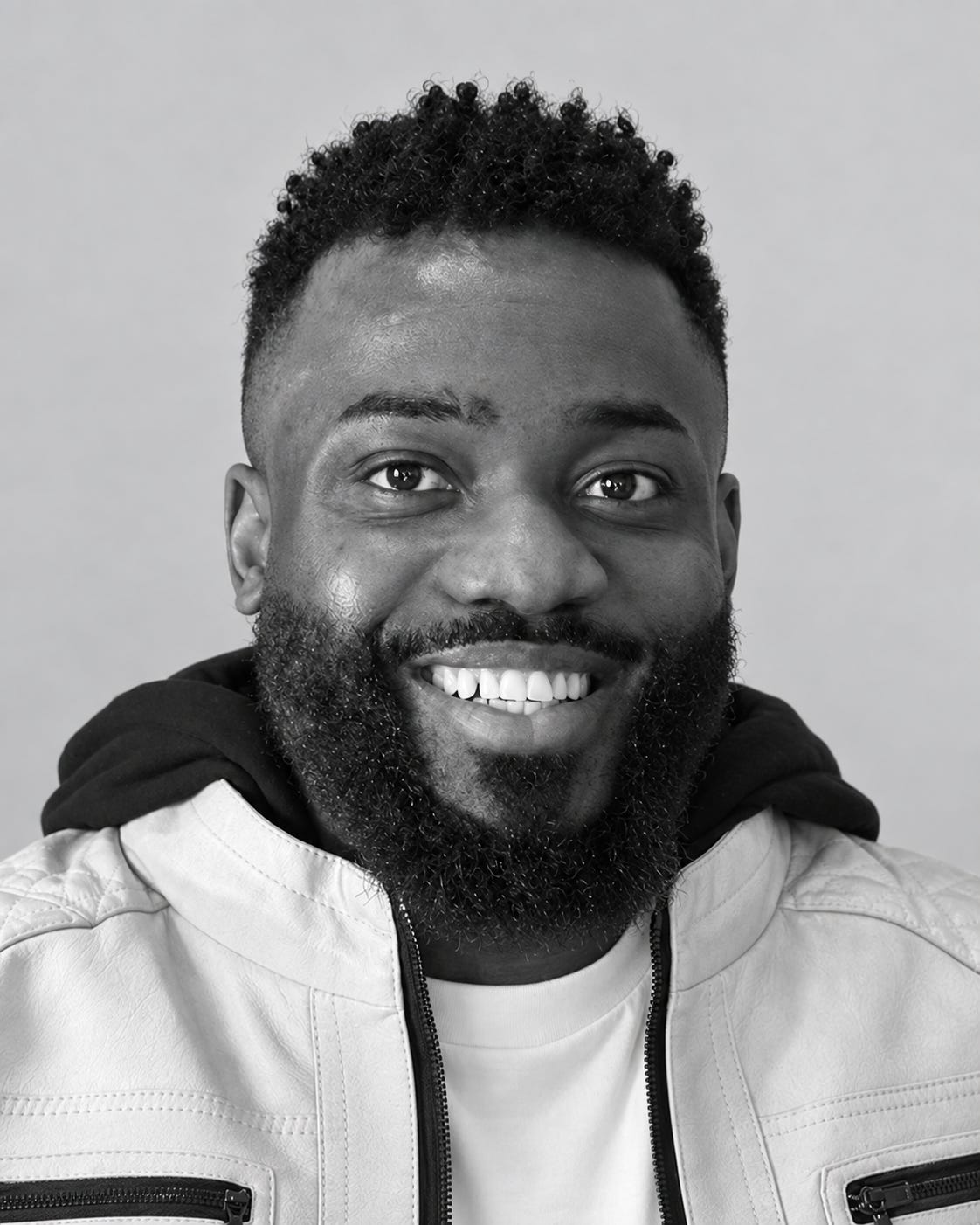
At Pikkah, he leads media and marketing, shaping the brand, growing the community, and developing partnerships in Nigeria. He's focused on that moment between someone noticing the problem and actually doing something about it. The interest is already there. What people need is to feel safe enough to take the first step.
Sam in Toronto. BJ in the US. Sheye in Lagos. The founding team is geographically positioned across the exact corridor their product serves, which is either a coincidence or the clearest possible signal that these are the right people to build this.
The friendship that became a founding team
Before Pikkah was a company, it was a friendship. Three of them, actually, woven together over years in the way that real partnerships form. Not at a networking event or an accelerator programme. Through life.
Sam and BJ have known each other since university. The kind of friendship where you’ve already seen each other through enough to know how the other handles pressure, disagreement, and the slow grind of building something from nothing.
BJ and Sheye met during their National Youth Service year in Abuja, over a decade ago. That friendship grew quietly over time until it became a working relationship that just made sense, the kind only time can produce.
So when the three of them came together around Pikkah, they weren’t strangers trying to build trust while also trying to build a company. They already trusted each other completely. That foundation, invisible to anyone looking at the product from the outside, is one of the biggest things Pikkah has going for it.
Building a startup is hard. Building a startup that is specifically about creating trust between strangers across international borders, with money moving between people who have never met, requires founders who trust each other absolutely first. Sam, BJ, and Sheye have had a decade to get there.
What existing shipping gets wrong
International courier services exist. They move enormous volumes. They do their job well for the things they are designed to handle.
The problem is what they are not designed to handle.
The item that's only sold locally and can't be ordered online. The purchase that hasn't happened yet because someone has to actually walk into the shop and buy it first. The small thing where the shipping costs more than the item itself, and everyone knows it. The one a store simply won't ship internationally, no exceptions, no discussion.

“For the people we are building for, buying the item can be easier than getting it home,” the Pikkah team said. “A store may not deliver to their country. The item may only be available locally. Or the delivery bill for one small purchase may be hard to justify.”
The informal favour economy that has grown up around this gap- the group chat messages, the Twitter requests, the family network activations- is not evidence that people have solved the problem. It is evidence that people have built workarounds for a problem nobody has properly solved.
Pikkah is the proper solution.
How Pikkah works: from request to doorstep
Pikkah is a marketplace connecting two types of people. Shoppers and Travellers. The simplicity of those words is intentional.
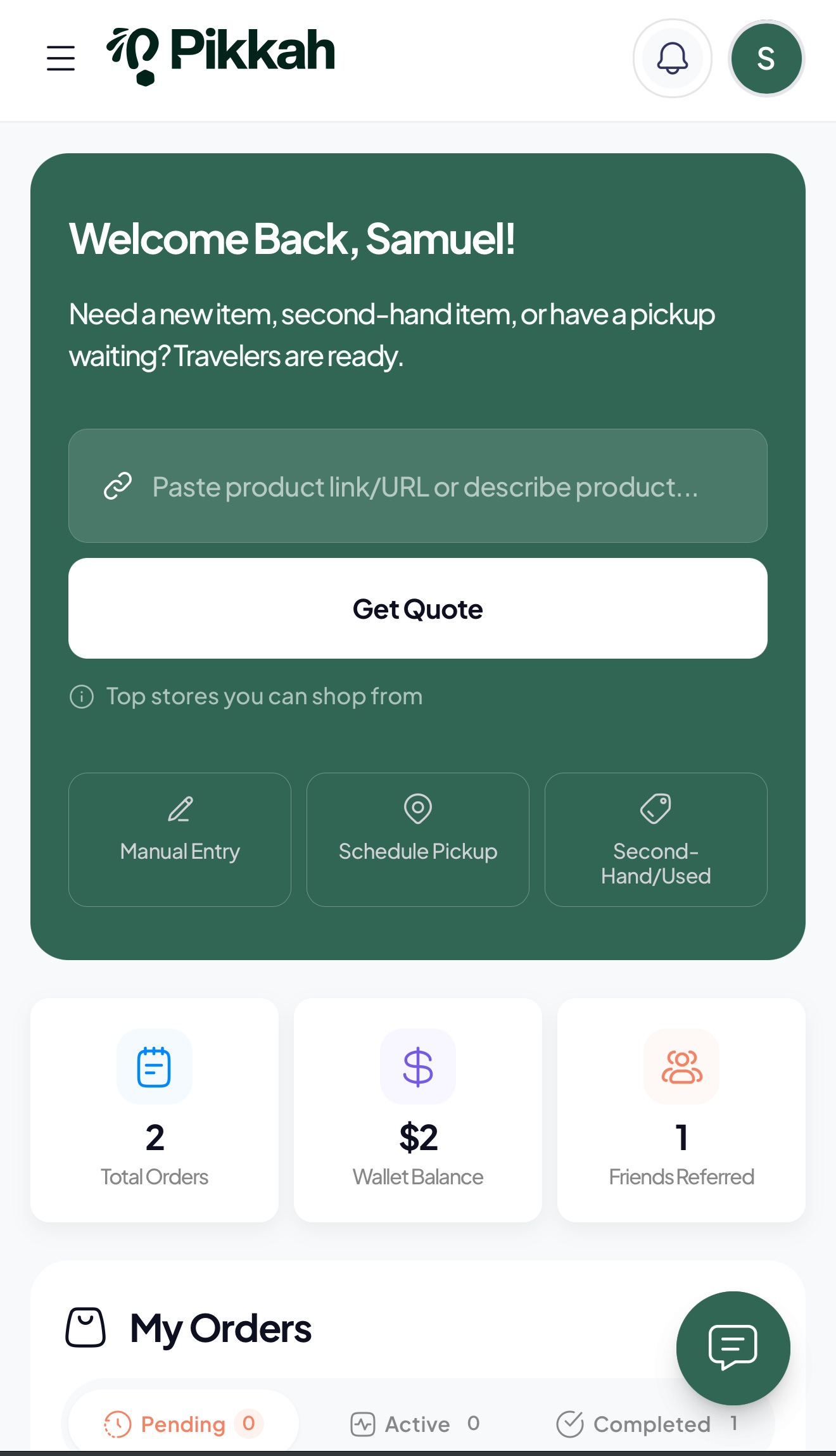
A Shopper is anyone who needs something brought from somewhere else. They post a request, a product link, a description of what they want, or details of something already purchased that needs to be collected and carried. They specify the route, the timeline, and what they need for delivery.
A Traveller is anyone making a journey who has luggage space they are willing to use. They post their upcoming trip, destination, dates, available space, and Pikkah matches them with suitable Shopper requests. Before accepting anything, the Traveller sees everything: the item, its weight, its value, where it needs to come from, and the reward being offered.
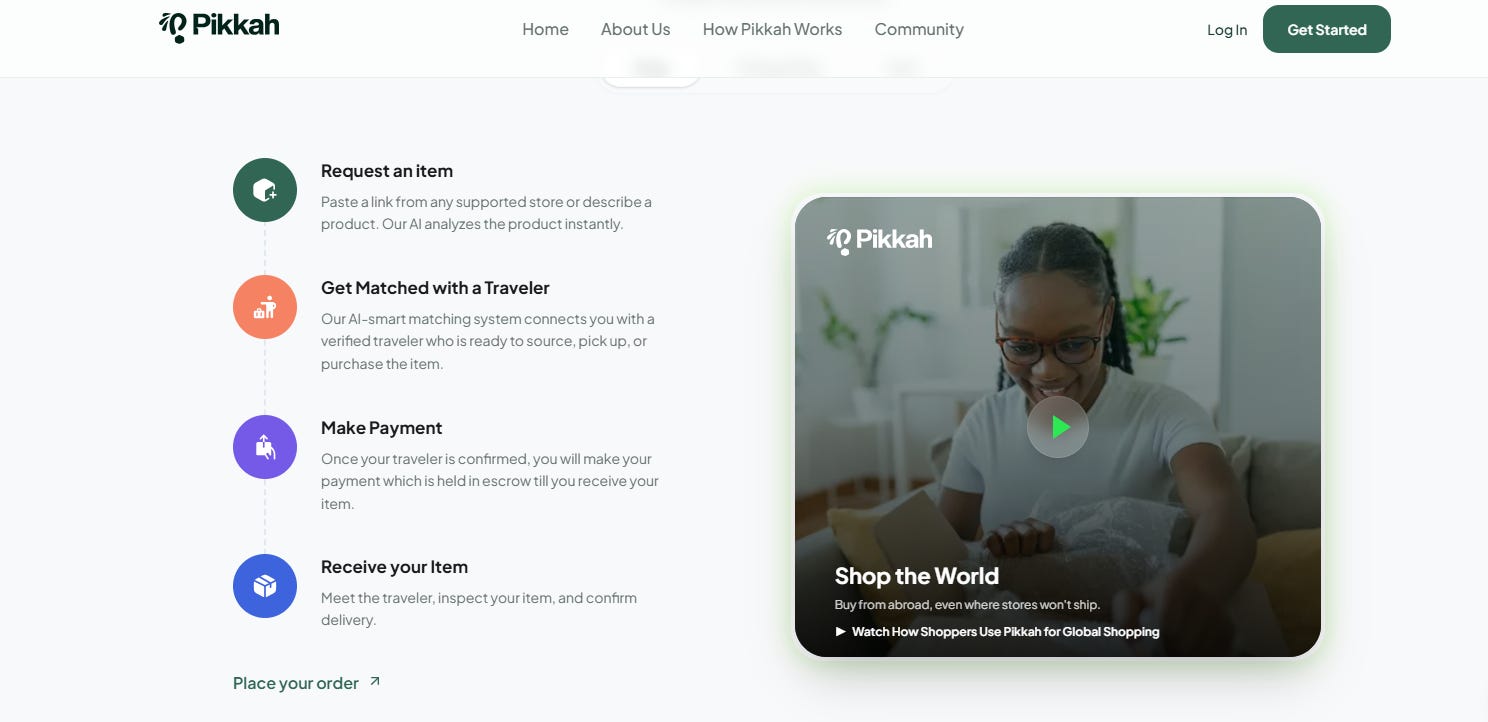
If the Traveller is also buying the item on the Shopper’s behalf, which is often the case, Pikkah handles the payment. The Shopper’s money is held securely until the item is confirmed delivered. The Traveller only receives their reward after the Shopper confirms that everything arrived correctly.
The whole chain, from request to purchase, carry, deliver, confirm, and pay, happens on one platform. No group chat coordination. No hoping someone follows through. No awkward conversations about reimbursement. Just a clear arrangement, agreed upfront, with accountability built in from the start.
The trust problem, solved from the inside out
This is the question every person has when they first hear about Pikkah: how do you trust a stranger to carry your item? Buy it correctly? Show up at the handover point?
It’s a fair question. Pikkah didn’t answer it with good intentions or community guidelines; they built accountability directly into the system.
Every user verifies their identity before joining. Trip verification confirms a Traveller’s offered journey is real. The items are checked for eligibility before any match is made.
Payments are held in escrow and only released when both parties confirm the handover is complete. Every completed transaction builds a public reputation, visible to the next person who encounters that profile.
The informal favour system works because social relationships carry their own accountability. When your cousin asks you to bring something, you follow through because you will see her at Christmas. Pikkah replaces social accountability with structural accountability, verification, escrow, reviews, and clear terms both parties agree to before anything moves.
This is where all of Sheye's work at the top of the funnel is headed. Someone hears about Pikkah, recognizes a problem they've lived with for years, and then needs a reason to actually try it with a stranger they've never met.
The brand, the community, the partnerships he is building in Lagos are all designed to close that gap, to turn recognition into trust, and trust into a first transaction.
The trust is not assumed. It is built into every layer of the experience.
Why this matters more than it looks
The informal "bring this back for me" economy among Nigerians is vast and unquantified. Nigerians living abroad send billions of dollars home annually, and with that money comes a significant movement of goods, personal items, packages, and purchases that traditional courier and logistics companies don't track.
This exchange occurs through personal networks, built on years of favours given and received, and the generosity of individuals willing to make space in their luggage for loved ones' essential items.
Pikkah is developing a system to make this economy accessible to everyone, not just those fortunate enough to know someone travelling the right route at the opportune moment.
Travellers can earn money by utilizing their unused luggage space, while Shoppers can acquire items they otherwise couldn't without difficulty, high costs, or compromise. What was once an informal transaction, prone to uncertainty, awkward conversations, and reliance on goodwill, now operates with clear terms, payment protection, and mutual accountability.
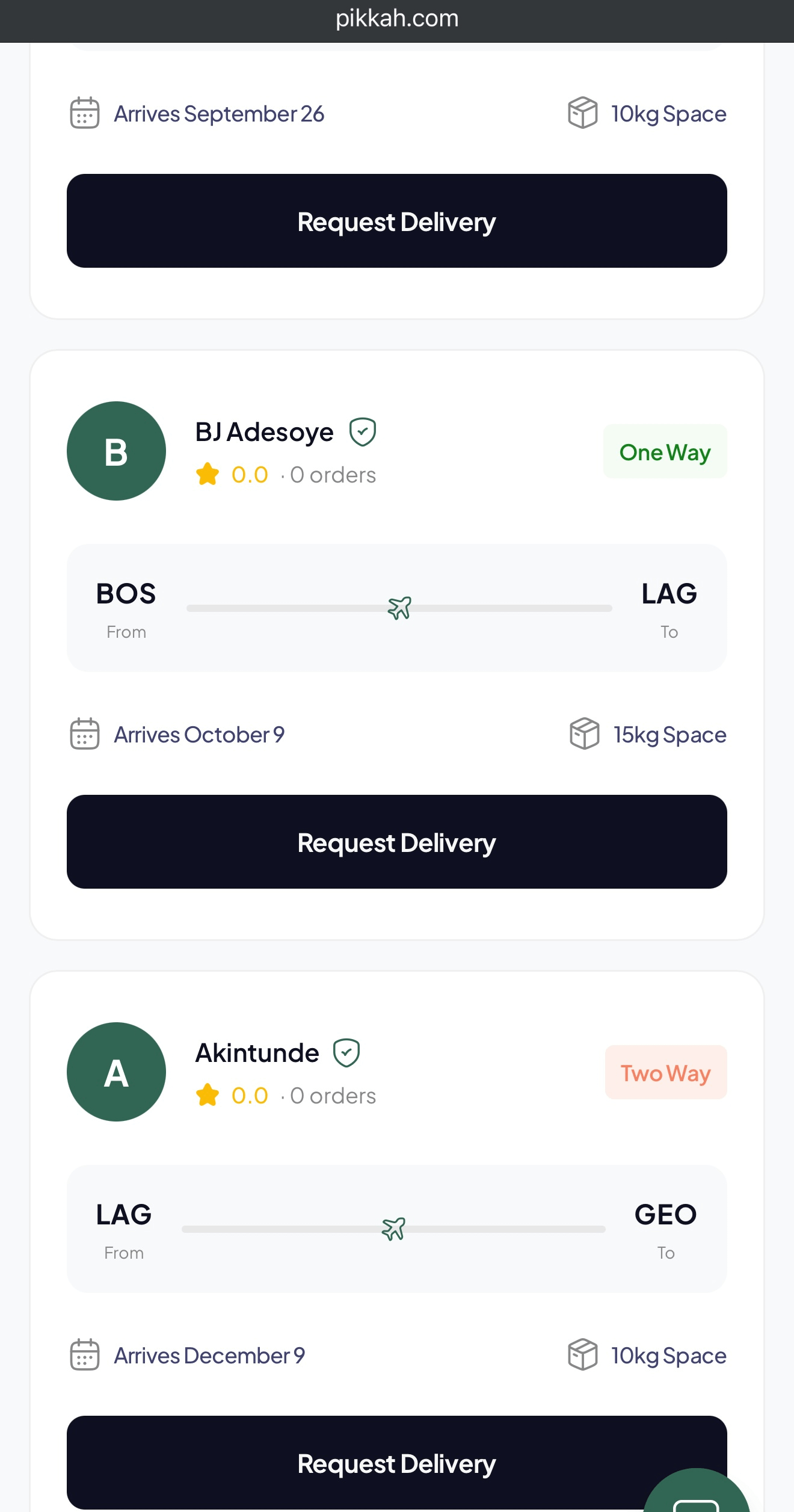
The core act of assistance remains the same, but the surrounding system has been transformed.
Sam manages operations, BJ develops the product, and Sheye fosters the trust that draws people to the service.
Thanks to them, a wedding outfit in Toronto arrives precisely when it's needed.