


Picture this. You are a driver who has clocked thousands of trips on Uber. Every week, the money lands in your account. You have a track record. You have consistent income. You have receipts, digital ones, right there on the platform.
And then you walk into a bank and ask for a loan.
They ask for a payslip. You don’t have one. They ask for a salary letter. You don’t have that either. You have an Uber dashboard full of earnings data, but the bank’s system was built for a world where work looks like a 9-to-5 with a stamp on paper. Your world doesn’t fit. Application denied.

This is not a rare edge case. This is the daily reality for hundreds of millions of people, gig workers, freelancers, content creators, Shopify merchants, YouTube creators, all earning real money on platforms the traditional financial system simply cannot see.
The World Bank estimates 435 million people earn through online gig work alone globally. Most of them are credit-invisible. Not because they are broke. Because the bank has no way to see what they earn.
Elo Mukoro saw this gap and decided to build the bridge.
Cr3dentials, pronounced “credentials”, is a US-based verification infrastructure company that sits between lenders and the platforms where people actually earn. Founded by Elo, who is Nigerian, and his co-founder, who is Ghanaian, Cr3dentials plugs directly into platforms like Uber, YouTube, Shopify, PayPal, Upwork, and Deel, and verifies a borrower’s income, assets, activity, and reputation on behalf of lenders.
In plain English: if you earn on a platform, Cr3dentials can prove it, privately, cryptographically, and instantly, so that a lender can finally say yes to you.
“We provide verification. We plug directly into platforms like Uber, PayPal, YouTube, Upwork, and we verify income, assets, activity, and reputation from these platforms, then share this data with the verifier or the lender. We work with lenders and companies worldwide.” — Elo Mukoro, Founder, Cr3dentials
The technology behind it is called zkTLS, zero-knowledge Transport Layer Security. It sounds like something only an engineer could love, but the idea is actually elegant. When you log into your Uber driver dashboard or your YouTube Studio, Cr3dentials generates a cryptographic proof of what’s in that session, your earnings, your activity, your revenue, without ever seeing your login credentials or storing your raw data.
Think of it like a notary that can confirm your bank balance is above a certain threshold without ever reading your statement out loud in the room. The proof is tamper-proof, verifiable, and requires no permission from the platform. If it’s on the web, Cr3dentials can verify it.
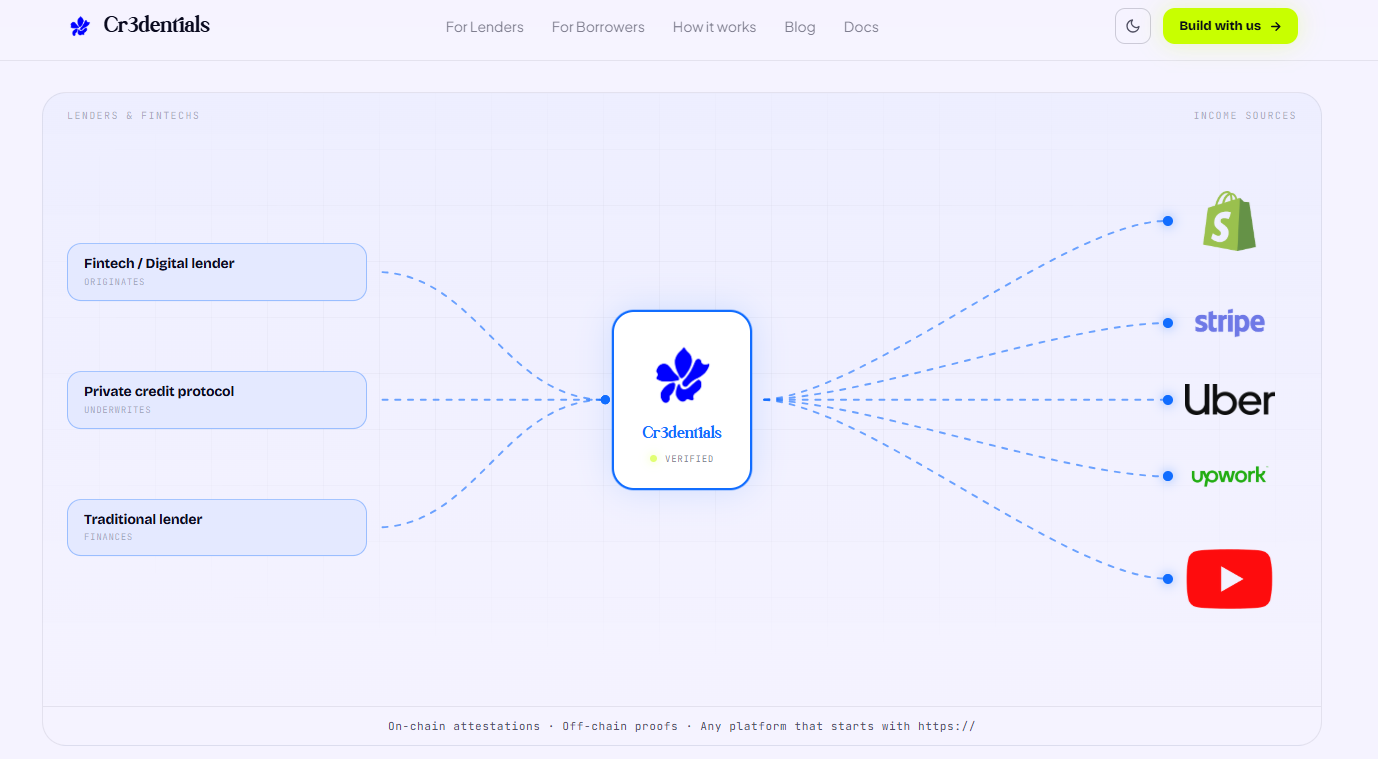
The whole process takes minutes. The lender sends the borrower a secure link. The borrower selects their platform, logs in inside their own browser, and Cr3dentials runs the verification behind the scenes, reading only the fields that were requested, generating the cryptographic proof, and delivering it straight to the lender.
No raw data stored. No credentials exposed. What used to take weeks of manual document review now happens almost instantly.
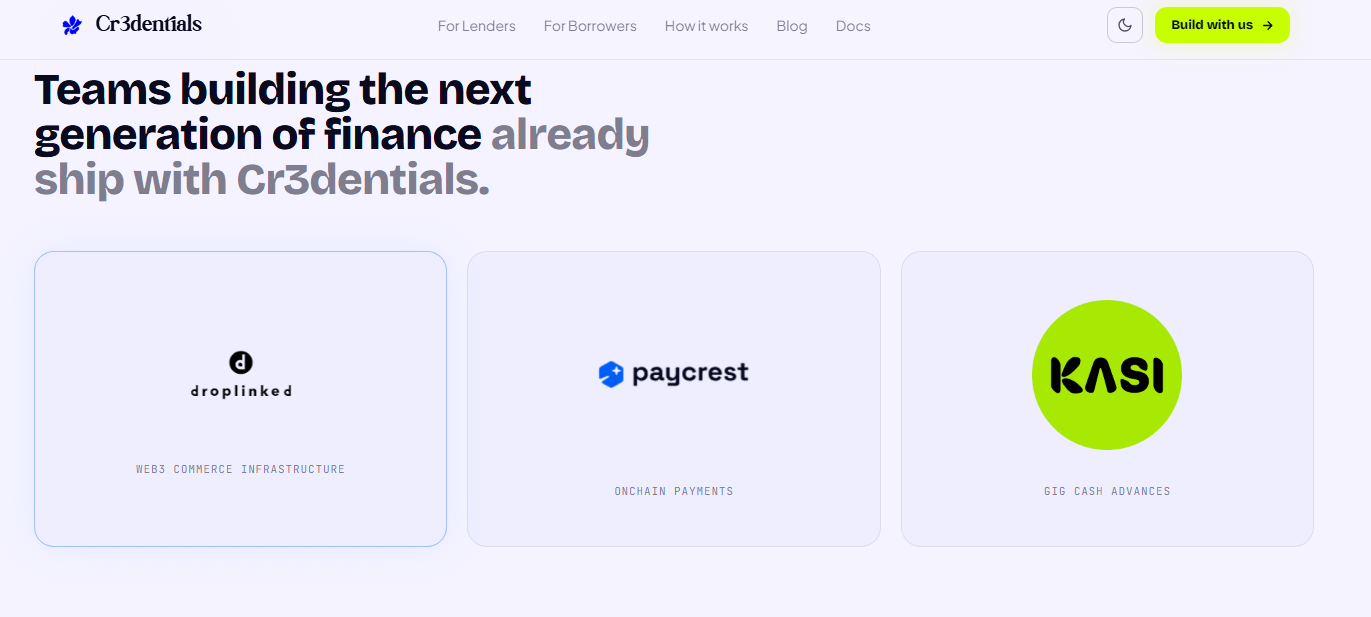
Cr3dentials currently has three live clients, and a pipeline of over ten more. Paycrest, the decentralized payments protocol, uses Cr3dentials to verify stablecoin off-ramp transactions across West Africa. KasiMoney, a neobank with 100,000 drivers in South Africa, uses it to verify Uber income and issue cash advances to drivers who would otherwise never qualify for credit. And Droplinked uses it to underwrite over 300 merchants in the MENA region, with loan products ranging from $50,000 all the way to $10 million.
That last number deserves a pause. This is not micro-lending. This is serious credit infrastructure for the platform economy, loans sized for real businesses, underwritten not on a payslip or a credit score, but on verified, cryptographic proof of real platform earnings.

The business model is clean: Cr3dentials charges lenders, not borrowers. A verification fee that scales down with volume, and a revenue share or loan origination fee for larger partnerships. The driver, the creator, the merchant, they simply connect their account and gain access to credit they were previously denied. No fee on their end. Just proof.
The Africa angle here is hard to ignore. Roughly half of adults in Sub-Saharan Africa are outside the formal banking system, but platform-based work is booming across the continent. Drivers on Bolt and Uber, creators on YouTube and TikTok, merchants building businesses online.
These are people with real, verifiable income that traditional lenders cannot touch. Cr3dentials is already changing that in South Africa and West Africa, and with ten more clients in the pipeline, the expansion is just getting started.
Two founders: Nigerian and Ghanaian roots, US-based, quietly building the verification layer that could unlock credit for millions of platform workers across Africa and the world. No paystub required.
That is exactly the kind of builder in60 exists to tell you about.
Learn more → cr3dentials.xyz
Building something in fintech or credit infrastructure across Africa? I want to hear from you. 📩 in60spotlight@gmail.com
Also, kindly read our previous newsletter. Click on this link
— Bankole Mubarak · Head of Newsletter, In60 · Telling the stories that matter.