

Among the new generation of African startups building interesting things with artificial intelligence, Cencori is taking a slightly different route. Rather than building another chatbot or AI-powered consumer app, the Nigerian startup wants to build the infrastructure that makes it easier for other people to create and run AI products.
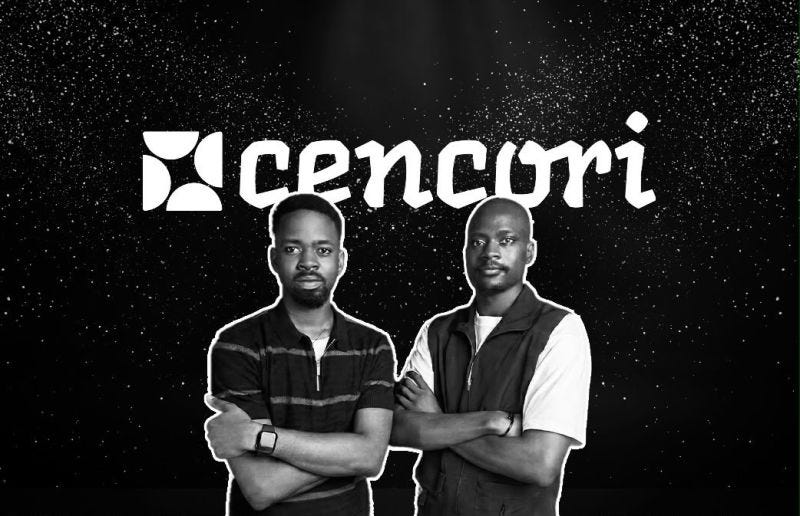
The idea came from a problem its founders, Bola Roy Banjo and Daniel Oreofe, kept encountering while building AI solutions for businesses. A client needed a voice agent. Another wanted an AI tool to handle customer conversations. Each project required weeks of work, even when the underlying technology was remarkably similar.

For Banjo, Cencori’s CEO, and Oreofe, its COO, the question became: why should developers have to rebuild the same capabilities every time they want to create something with AI? What if the essential tools were already available, ready to be plugged into whatever they were building?
That thinking became the foundation of Cencori, an AI infrastructure company the pair co-founded to make AI development more accessible, secure, and reliable. On November 18, the startup introduced Tensor, a product that lets people turn ideas into applications using prompts.
Tensor gives people a more visible way to experience what Cencori is building. But for its founders, the product is also part of a much bigger ambition: to build the infrastructure that could help power Africa’s next generation of AI companies.
The problem with building AI one client at a time
Cencori’s story goes back to Collabs, an AI services agency Daniel and his team started around 2022. The company helped businesses explore how artificial intelligence could fit into their operations, building products such as voice agents and custom AI tools for clients in sectors including hospitality and real estate.
The work gave the team practical experience with what businesses wanted from AI. It also exposed a problem that became increasingly difficult to ignore.
Building a solution for one customer could take four to six weeks. Then another customer would arrive with a similar requirement, and much of the process would begin again. The team was effectively solving the same technical problems repeatedly.
Daniel began thinking about how to make those capabilities reusable. Rather than asking developers to assemble every component themselves, Cencori would provide infrastructure they could plug into their applications.
The idea was to make AI development more like connecting ready-made building blocks than starting from scratch.
Finding the right technical partner was an important part of making that possible. Daniel put out a call on X looking for AI engineers, and that was how he connected with Bola Banjo, who would become his co-founder.
What began as an effort to make AI product development more efficient grew into a company focused on the systems that allow those products to work.
One of its central products is an AI gateway.
A gateway sits between an application and the AI models powering it. When a developer builds an application using a model from OpenAI, Anthropic or Google, for example, the application needs a way to communicate with that provider.
The difficulty is that an application can become dependent on one provider. If that model experiences an outage or becomes unavailable, the application relying on it could stop working too.
Cencori’s gateway is designed to help developers avoid that single point of failure by routing requests across different model providers. If one provider becomes unavailable, the system can switch to another supported model.
Daniel compared the idea to having a backup power source. A business should not have to shut down simply because its usual source of electricity is unavailable. In his analogy, the gateway works like a generator: when one source fails, another can take over.
There is also a security layer. Cencori says its system can identify and remove sensitive personal information, such as phone numbers, email addresses, and physical addresses, before an application’s request is sent to an AI model. It uses placeholders to preserve the context of the request and can restore the relevant information in the response.
The platform also includes monitoring tools that help developers observe how their AI applications behave, alongside security features designed to detect risks such as prompt injection.
These may sound like technical details, but they address practical problems. A developer building an AI product should not have to independently assemble model routing, security, monitoring, and other infrastructure before getting to the part of the product customers actually use.
Cencori wants to bring those pieces together.
From infrastructure to something people can build with
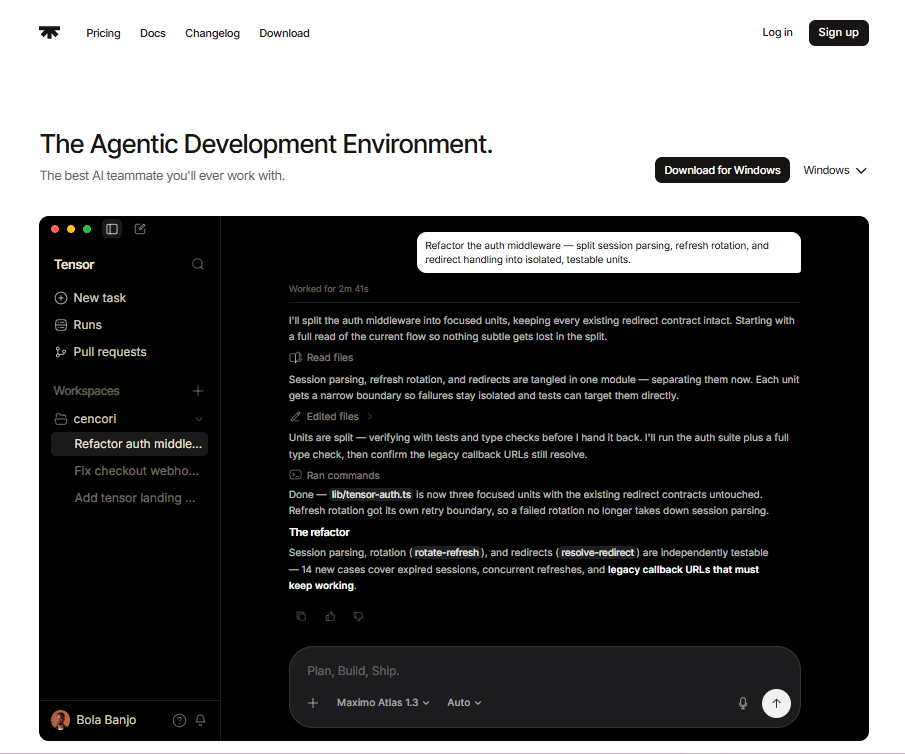
That brings us to Tensor. The product launched on November 18. It takes some of the capabilities Cencori has been developing and puts them into a more accessible product. Instead of requiring users to write every line of code themselves, it lets them describe what they want to build through prompts.
During the interview, Daniel demonstrated how he could use a prompt to create a game, then publish it. He said the exercise cost him about ₦2,000. The demonstration offered a glimpse of the idea behind Tensor: making it easier for people to move from having an idea to building something they can actually use.
It is also a way for Cencori to reach beyond developers already familiar with AI infrastructure. The company wants people to build applications with Tensor, while its underlying technology helps power those applications.
Daniel’s ambition is for the products created through Tensor to become evidence of the platform’s usefulness.
“We want people to come out there and say they built so and so solution which was powered by Tensor. That would be a metric for us that we are winning,” he said.
It is a different way of measuring success from simply counting sign-ups. The real test is whether people can use the product to create things that work and that other people find valuable.
Cencori is also trying to make its infrastructure accessible to developers who may not have the resources to pay for several separate services. Daniel described a model that brings multiple tools together, rather than requiring a small team to manage different vendors, integrations, and contracts.
The company has put a price of $20 on a package of features, although the precise scope of what is included will be important for developers evaluating the offer.
There is a market opportunity here, particularly in Africa, where developers are building increasingly ambitious products but may not have the same access to capital, computing resources, and technical infrastructure as teams in larger technology markets.
Cencori wants to reduce some of that friction.
Daniel sees a bigger ambition than software for Cencori
The company’s ambitions stretch beyond making AI development easier.
Daniel wants Cencori to eventually become a deep-tech company involved in the computing infrastructure behind artificial intelligence. That includes an ambition to build hardware, including chips and GPUs, rather than relying indefinitely on infrastructure developed elsewhere. He has described the vision as building something similar to Nvidia for Africa.
It is an enormous ambition, especially for a young company still working to establish its software products. But Daniel sees the current infrastructure work as a starting point, not the final destination.
Cencori has joined the Nvidia Inception programme, which gives participating startups access to resources and support from the chipmaker’s ecosystem. Daniel hopes the relationship can help the company get technical guidance, including feedback on its architecture, and improve its access to GPU resources.
That does not mean Nvidia has invested in Cencori or that the company has secured a hardware partnership. For now, the programme is an opportunity to learn from and engage with an established player in the computing industry. The immediate challenge is making the business work.
Daniel said Cencori is bootstrapped and has a team of about five people, including two to three engineers. Building and maintaining AI infrastructure is expensive, and the company is operating in a market where enterprise adoption of AI is still developing.

There is also an explanation problem. Selling an application is relatively straightforward: customers can see what it does. Selling infrastructure is harder because much of its value sits behind the scenes. Investors and potential customers have to understand why the underlying systems matter before they can appreciate what the company is building.
Cencori has attracted interest from investors, but Daniel said the company has not formally begun fundraising. His priority is to build a strong business rather than rush into raising capital.
The company is approaching 1,000 users and has processed more than five billion tokens, according to Daniel. Its target is to reach 100 billion tokens by the end of 2026. Tensor, meanwhile, has a target of 10,000 users.
Over the next five years, Daniel wants Cencori to serve one million developers globally. In that picture, Tensor helps people create products, while Cencori provides the infrastructure that powers them.
It is a long way from building AI tools for individual clients. But that experience is precisely what gave the founders the idea in the first place.
They saw how much time developers were spending rebuilding similar things. Now they are trying to make those building blocks available to everyone else.
Tensor’s launch gives that ambition a more visible starting point. Whether Cencori can grow from a collection of developer tools into the deeper computing infrastructure Daniel imagines will depend on how well it solves the immediate problems in front of it, and whether enough developers choose to build on top of what the company is creating.

The useful decision is starting with the thing they kept rebuilding for clients, voice agents and the same customer-conversation stack, rather than leading with the Africa's Nvidia line. A prompt-to-app product like Tensor, introduced on 18 November, is easy to demo and harder to trust once a team has to put real customer data and uptime behind it. The test is whether a second developer can ship without the founders in the loop, and whether the secure and reliable part is a default or a slide. Is Tensor the infrastructure, or a storefront while the actual platform is still the services work that came out of Collabs?