For some job seekers, a typical day can feel like a full-time job in itself. You scroll through LinkedIn, open a promising vacancy, adjust your CV, write a cover letter, and submit your application. Then you do it again. And again. Sometimes, you send out dozens of applications without hearing anything back.

After a while, the silence begins to feel personal. You start questioning your skills, your experience and whether you are good enough for the career you have spent years trying to build.
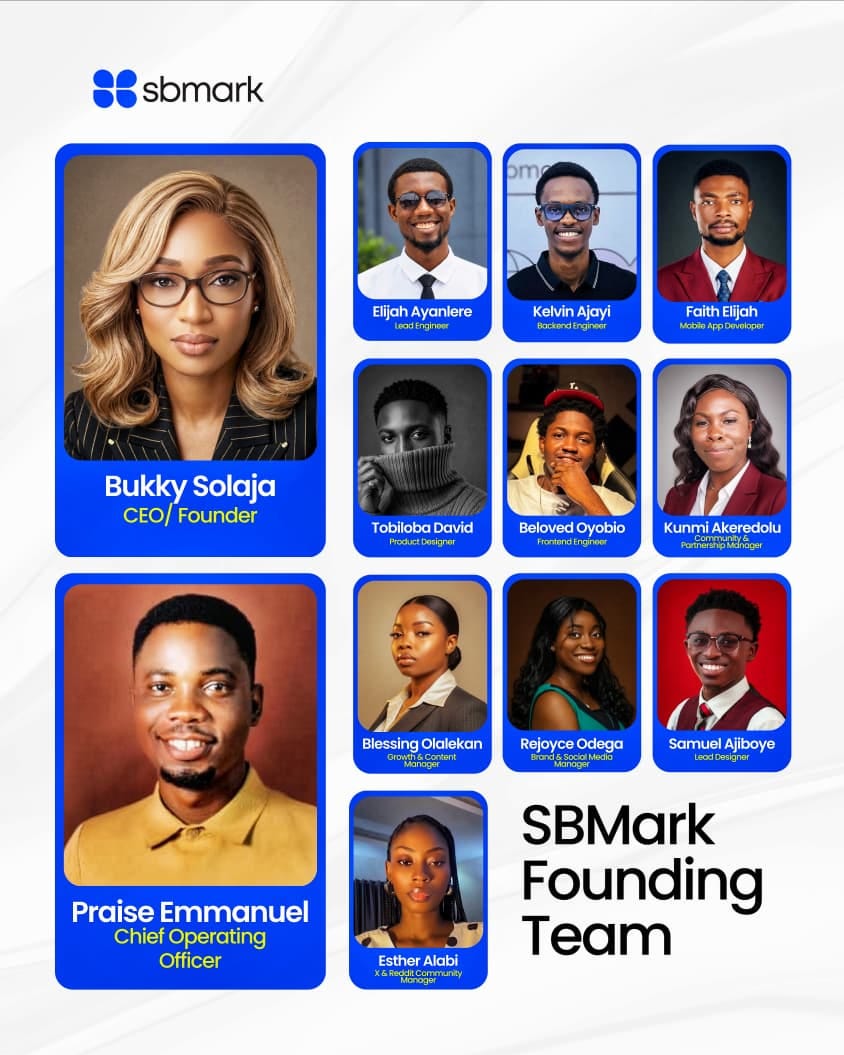
Bukky Solaja has seen what that process can do to people. After more than 12 years in product management, including time spent hiring candidates and reviewing over 1,000 applications, she understands that getting a job involves more than having the right qualifications. You also need to know how to communicate your value, identify the right opportunities and make your experience relevant to what an employer actually needs.
But it was her experience training other professionals that made the problem more personal.
Solaja started SBMark in 2021 by helping technology professionals rewrite their CVs and prepare for interviews. As more people approached her for guidance in business analysis, Agile, Scrum and product management, she began teaching larger groups, sometimes with more than 40 students in a 12-week programme. She has since trained over 200 professionals.
Some found jobs quickly after completing the training. Others spent months searching, with some taking as long as a year. For Solaja, the hardest part was watching capable people interpret those struggles as proof that they were not good enough.
“What broke my heart was seeing some of them take rejection as a verdict on their worth,” she says.
Some eventually abandoned the careers they had worked towards and returned to jobs they had hoped to leave behind. Solaja knew they had the skills, but she also realised that having those skills did not automatically translate into knowing how to navigate the job market.
She could help people one at a time, but there was a limit to how many she could reach while maintaining her own corporate career. She wanted to build something that could offer that guidance to more people, even when she was not personally available to help.
That ambition is now taking shape in SBMark, an AI-powered career platform built around a simple instruction: “Stop applying blind. Check before you apply.”
Why sending more applications may not be the answer
Job seekers are often encouraged to apply widely. The logic seems reasonable: the more applications you send, the better your chances of getting a response. But Solaja believes that approach can leave people exhausted without helping them understand why their applications are not working.
“We’ve confused activity with progress,” she says. “Applying to hundreds of roles feels productive because you’re doing something. But sending 100 applications a day, or using a tool to send even more, and hoping someone calls back is not a strategy. Hope is not a strategy.”
From her experience as a hiring manager, a high volume of generic applications does not necessarily make a candidate stand out. It can make it harder for employers to identify the people who genuinely fit a role.
There is also the amount of work involved in each application. A candidate might have a job description open in one tab, their CV in another, a company website in a third, and an AI chatbot helping with a cover letter. They still have to connect all that information and decide whether the opportunity makes sense.

Solaja sees a job description as more than a list of qualifications. It is an employer explaining a problem it needs someone to solve, whether that means improving a product, coordinating a team, fixing a process or delivering a business result.
A candidate’s task is to show how their experience connects to that need. Simply copying keywords from a job advert or listing previous responsibilities may not be enough.
This is the thinking behind SBMark’s AI career partner, MARK. Instead of pushing users to submit more applications, the platform is designed to help them assess an opportunity, understand their strengths and gaps, tailor their CV, contact relevant people and prepare for interviews.
An AI assistant that can tell you not to apply
One of MARK’s central features is its three-part verdict: Apply, Strengthen First or Skip. The idea is to help candidates make a more informed decision before spending hours preparing an application.
MARK assesses two things together: the health of the opportunity and the candidate’s fit for the role.
Opportunity Health looks at signals such as how old a job listing is, whether it appears to be active and whether it has been reposted. Competitive Fit compares the job’s key requirements with the candidate’s CV and Career DNA, a profile intended to capture their experience and skills. It then identifies where the candidate has strong evidence, partial evidence or gaps.
A candidate who meets most of the important requirements and has evidence to support their experience may receive an Apply recommendation. Someone who appears competitive but needs to present relevant experience more clearly may be told to Strengthen First. Skip is intended for roles with substantial gaps, hard eligibility requirements the candidate does not meet, or serious concerns about the opportunity.

The distinction matters because a missing keyword does not necessarily mean someone lacks the relevant experience. A person who has performed product management duties, for example, may have a different job title from the one an employer uses. A system that relies too heavily on titles or exact wording could overlook that person.
Solaja says MARK is designed to look for evidence of transferable experience rather than relying only on keyword matches. It also distinguishes between a qualification someone does not have and experience they have but have not explained properly.
“Unknown doesn’t mean bad, and poorly presented experience doesn’t mean someone lacks the ability,” she says.
The platform is also careful about what it can establish about a job listing. A vacancy can appear on a genuine company website even when the employer has already moved further along in its recruitment process. Unless that internal status is available, no external tool can confidently know whether the position is still open.
Solaja says MARK flags the warning signs it can identify and communicates uncertainty rather than presenting every assessment as a fact. An old listing is not automatically fake, just as a recently posted vacancy is not proof that a company is actively hiring.
When information is incomplete, users may still need to check the employer’s careers page or contact a recruiter. The goal, she says, is not to manufacture certainty but to help people decide where their time is best spent.
Making a CV stronger without making things up
A job seeker’s experience can be valuable and still be poorly presented. Someone who coordinated a product release, for example, might describe their work simply as “worked with engineering on product releases”. That statement may be accurate, but it does little to explain what the person actually contributed.
MARK is designed to help users make that experience more specific. It can ask follow-up questions about their responsibilities, the teams involved, and the results they achieved, then use their answers to improve the wording of their CV.
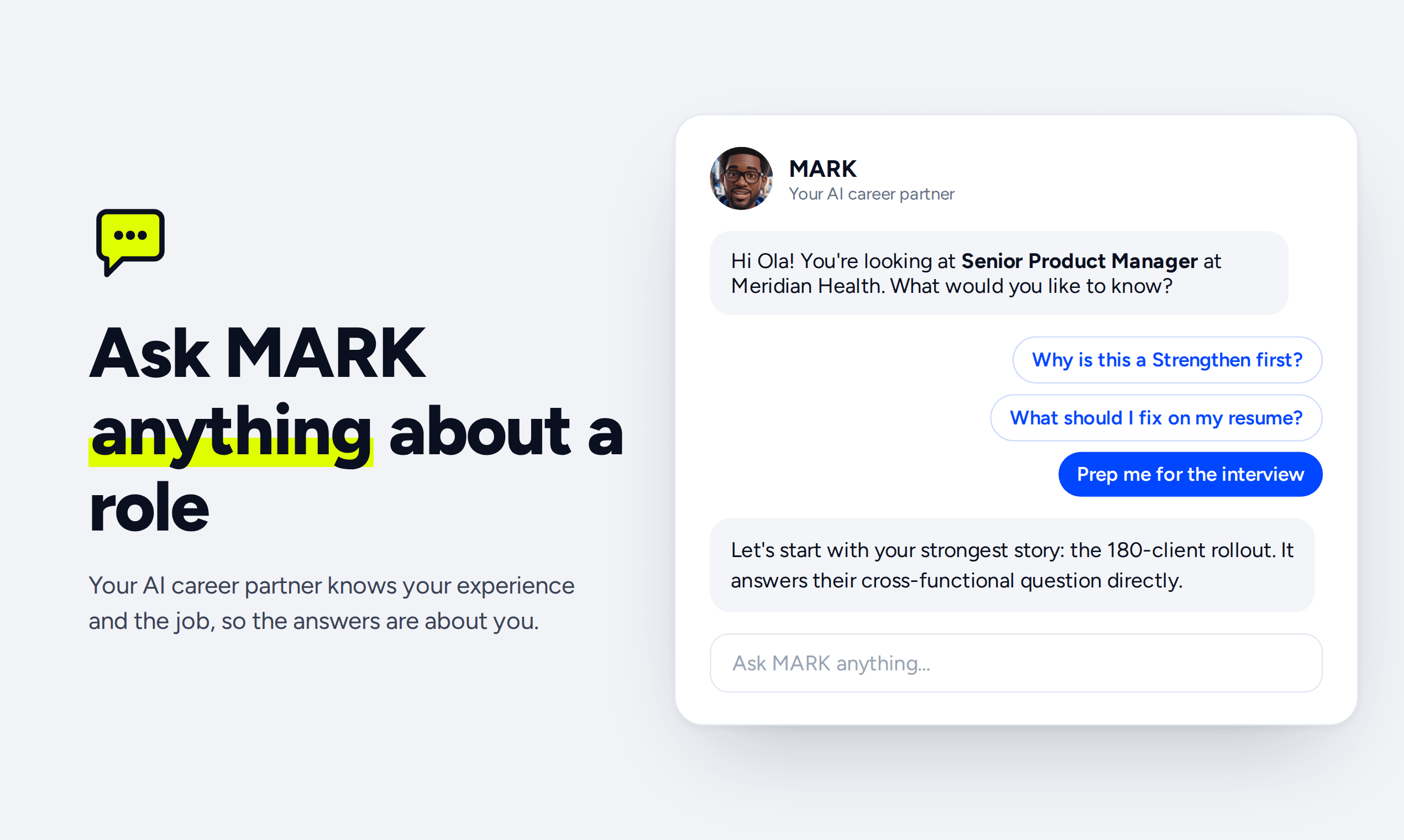
If the person genuinely prioritised a product backlog, coordinated business and engineering teams, and supported releases for a customer portal, the platform could help express those contributions more clearly. It should not invent a revenue increase, a team size or an achievement the candidate cannot substantiate.
“The principle is simple: make the experience clearer without inventing experience,” Solaja says.
Users approve the changes, and the same principle applies to personalised outreach messages and interview preparation. The aim is to help people explain their experience in a way that fits the opportunity without giving them a story they cannot defend when an interviewer asks questions.
For Solaja, that is an important distinction in an era when AI tools can generate polished CVs and cover letters in seconds. Making every candidate sound impressive is not the same as helping employers understand what each person can actually do.
A career tool for people who already have jobs
SBMark is not intended only for people who have been laid off or are desperate to leave their current jobs. Solaja wants professionals to pay attention to their careers before they are forced to make a move.
“Because your career deserves your attention even when you have a job,” she says. “A company gives you a job. Your career is your responsibility.”
When people wait until a difficult manager, a layoff, or burnout pushes them into the job market, they may have to reconstruct years of achievements, update their CVs and learn what employers want while already under pressure.
SBMark aims to help employed professionals document their progress, understand their strengths and identify the skills gaining importance in their fields. That could help someone prepare for a promotion, negotiate for better pay, move into a different industry or simply understand what opportunities might be available.
Solaja describes the goal as helping people maintain options rather than waiting until they have none.
Building SBMark with its first users
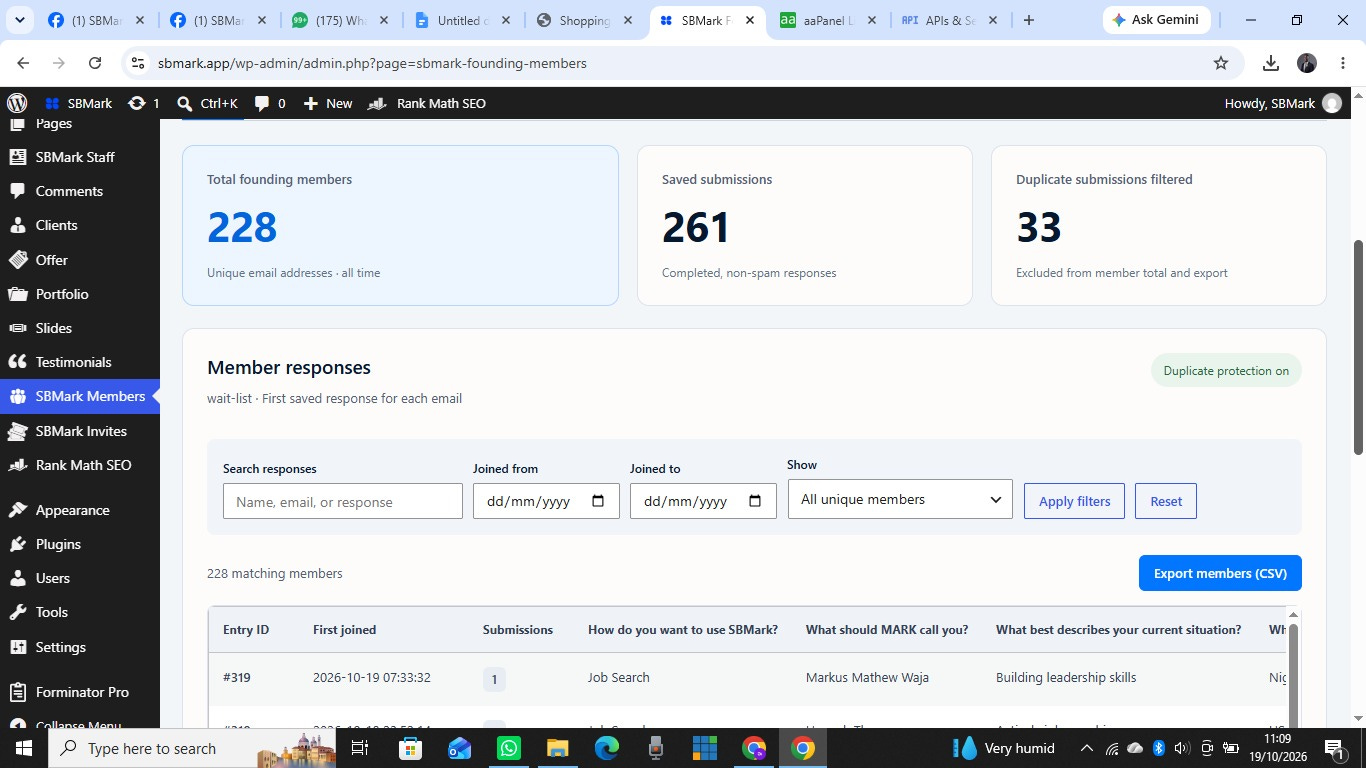
SBMark launches publicly on November 21, 2026, in Nigeria, the US, the UK and Canada. It opened 3,000 Founding Member places across those markets and currently has 228 members, all with access to pre-launch testing.
These are founding members, not people yet using a launched product or finding jobs through it; SBMark says it has no active users outside testing and will report verified outcomes after launch.
Tester feedback has already driven changes: a better experience for people exploring before uploading a CV, a redesign of parts of the interface, and a wider range of jobs.
The company will measure impact through relevant responses and interviews per application, time spent preparing, job offers and users’ confidence in career decisions, and by understanding what a better opportunity means to each person, whether higher pay, better conditions, a preferred location or a successful career change. These results will take time, and SBMark has yet to show that MARK improves hiring outcomes at scale.
That is a key test in a crowded market of AI CV builders, interview coaches and automated job-search tools. If AI makes polished applications easy for everyone, the advantage may lie less in generating more documents than in helping people judge which opportunities deserve their attention.
Solaja warns against AI simply speeding up the same cycle: more applications, more generic submissions, faster rejections.
“That’s why SBMark won’t mass-apply for you,” she says. “We’d rather help you send ten applications that matter than a hundred that don’t.”
Over the next three years, she wants SBMark to be a career partner people return to throughout their working lives, and to help employers discover relevant professionals, with candidates controlling when and how their information is shared.
Success won’t be measured by applications generated but by real change in people’s working lives: a stronger interview pipeline, a promotion, better pay or a clearer sense of where to go next. For Solaja, helping someone understand their value and find a fitting opportunity beats another hundred applications disappearing into the void.